
One Chinese character is one story: The magic of pictographic characters
Why do Chinese characters look like paintings? Because they were originally paintings. Using the analogy of “prehistoric cave paintings,” this guide helps you understand pictographic characters, oracle bone inscriptions, and why a Chinese name is a set of side-by-side “small paintings.”
📝 TL;DR Summary
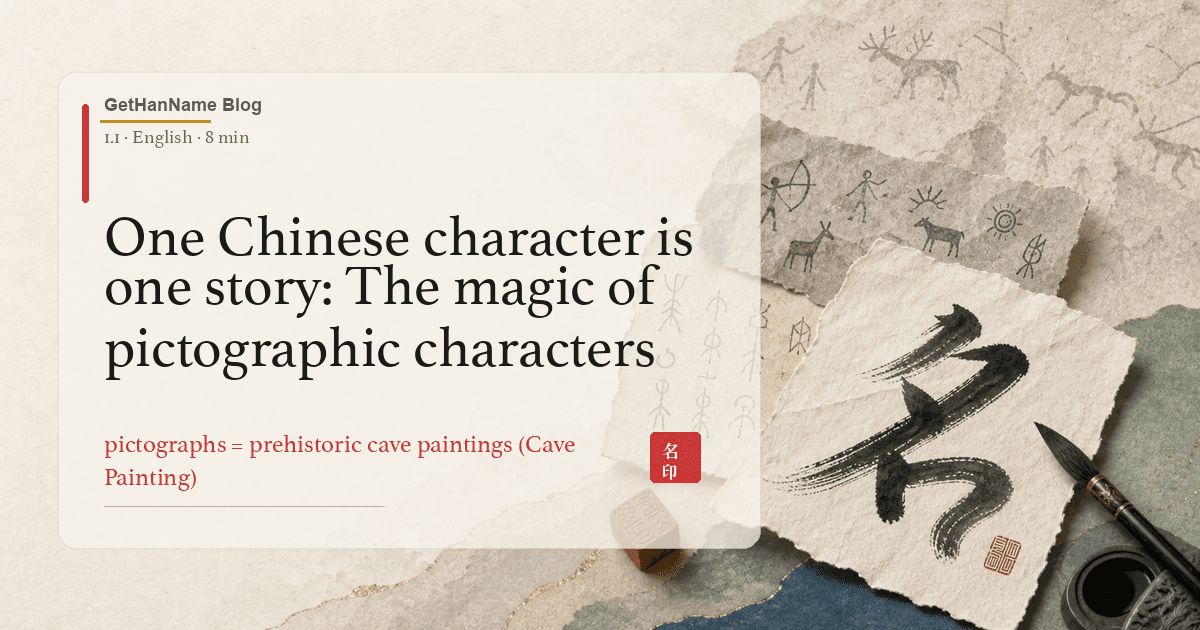
Chinese characters may look like drawings because they were originally created that way. Think of pictographic characters as Cave Paintings from prehistoric times—tens of thousands of years ago, early humans used pigments to depict the cattle and horses they saw on cave walls. Similarly, the Chinese employed knives and brushes to “paint” images of the sun, moon, and mountains into their writing system, a tradition that has persisted for over 3,000 years to this day. This 8-minute guide will help you understand why each Chinese character is, in itself, a whole story.
I. Introduction
If you visit the Lascaux caves in southern France or the Altamira caves in Spain, you’ll see entire walls covered with depictions of running bison and horses—creations painted by prehistoric humans to capture the world as they saw it.
They had no formal “painting techniques” to learn; they simply painted whatever they observed. This instinct to directly render what was seen appears in nearly every ancient civilization.
The Chinese took this practice to an extraordinary level: not only did they depict the world, but they also passed down these “paintings” from generation to generation, eventually evolving them into a sophisticated writing system capable of recording poetry, laws, medicine, and philosophy.
These earliest forms of “painting” are the ancestors of today’s Chinese characters—ideographic symbols.
📌 This article uses the analogy of Cave Painting to explain the origins of Chinese characters and why a Chinese name carries a unique “visual sense” that a phonetic name simply cannot replace.
II. Exploring the Core Analogy: Pictographic Characters = 3,000-Year-Old “Cave Paintings”
Let’s first clarify two key terms.
Pictographic characters (xiàngxíngzì), as the name suggests, are “characters drawn to represent shapes” — they use lines to depict what an object looks like.
Oracle-bone script (jiǎgǔwén) is the earliest known fully developed writing system in China, carved onto turtle shells and animal bones over 3,000 years ago. It serves as our clearest window into pictographic characters as they appeared in ancient times.
He Rongzhu, a researcher in name studies, describes pictographic characters using the principles summarized by ancient scholars:
“According to the ‘Six Categories of Characters,’ pictographic characters are defined as ‘drawing the object itself while adapting the strokes to its form.’ In simpler terms, they are created by using lines or strokes that mirror the appearance and shape of objects, items, or animals.”
—— He Rongzhu, Textbook of Name Studies, China Materials Publishing House, 2012
“Drawing the object itself” — essentially drawing it down. This is exactly the same logic behind cave paintings.
Let’s take a look at six of the most common characters. From oracle-bone script to today’s standard regular script, the trace of that “drawing” remains clearly visible:
| Chinese Character | What It Was “Drawn” as in Oracle-Bone Script | Today’s Regular Script |
|---|---|---|
| 日 | A circle with a dot in the center (the sun) | 日 |
| 月 | A crescent moon with a notch pointing downward | 月 |
| 山 | Three connected mountain peaks | 山 |
| 水 | Ripples representing flowing water | 水 |
| 人 | A person standing sideways with a bent back | 人 |
| 木 | A tree with branches above and roots below | 木 |
- Chinese Character
- 日
- What It Was “Drawn” as in Oracle-Bone Script
- A circle with a dot in the center (the sun)
- Today’s Regular Script
- 日
- Chinese Character
- 月
- What It Was “Drawn” as in Oracle-Bone Script
- A crescent moon with a notch pointing downward
- Today’s Regular Script
- 月
- Chinese Character
- 山
- What It Was “Drawn” as in Oracle-Bone Script
- Three connected mountain peaks
- Today’s Regular Script
- 山
- Chinese Character
- 水
- What It Was “Drawn” as in Oracle-Bone Script
- Ripples representing flowing water
- Today’s Regular Script
- 水
- Chinese Character
- 人
- What It Was “Drawn” as in Oracle-Bone Script
- A person standing sideways with a bent back
- Today’s Regular Script
- 人
- Chinese Character
- 木
- What It Was “Drawn” as in Oracle-Bone Script
- A tree with branches above and roots below
- Today’s Regular Script
- 木
Keep in mind, this isn’t just “coincidental similarity” — it’s intentional drawing. He Rongzhu gives examples in his book: “The character ‘日’ looks like a circle with sunspots in the center; ‘月’ resembles the shape of a bright crescent moon; ‘龟’ takes on the side profile of a turtle... The character ‘门’ is simply the shape of two doors side by side.” (Textbook of Name Studies)
To help you better grasp this difference, here’s a comparison — both representing “sun”:
| Aspect | English word “sun” | Chinese character 日 |
|---|---|---|
| Origin | Composed of a sequence of phonetic letters | Drawn as a sun |
| Shape and Meaning | The letters s-u-n have no visual connection to “sun” | The shape itself is a simple sketch of the sun |
| Language Change | Meaning changes with pronunciation; it looks different in other languages | The shape remains unchanged; anyone who sees it recognizes it as a sun |
- Aspect
- Origin
- English word “sun”
- Composed of a sequence of phonetic letters
- Chinese character 日
- Drawn as a sun
- Aspect
- Shape and Meaning
- English word “sun”
- The letters s-u-n have no visual connection to “sun”
- Chinese character 日
- The shape itself is a simple sketch of the sun
- Aspect
- Language Change
- English word “sun”
- Meaning changes with pronunciation; it looks different in other languages
- Chinese character 日
- The shape remains unchanged; anyone who sees it recognizes it as a sun
Think of it this way: Alphabetic scripts are like phone numbers — a set of agreed-upon codes where the code itself has nothing to do with whether the person resembles it or not. Pictographic characters, on the other hand, are like identification photos — they directly capture what the object is.
This is precisely the essence of cave paintings: there is a visible connection between the symbol and what it represents.
III. Returning to Chinese Names: Why a Name Is Like a Set of Side-by-Side “Mini-Paintings”
Once you grasp this point, you’ll understand what makes Chinese names so unique.
In English, naming a child Grace (meaning elegance) relies on the definition provided in dictionaries. But in Chinese, including the character “明” in a name is essentially placing two paintings side by side:
「明」(míng)= 「日」(sun)+ 「月」(moon)
When the sun and moon are placed together, it represents “brightness.”
Take 「森」(sēn) as another example—three 「木」(trees) stacked on top of each other form a forest. There’s no need to memorize definitions; you can understand it just by looking at the image.
This is the magic of Chinese names: choosing a character isn’t about picking a “sound label”; it’s about selecting a painting or a story to place in your child’s name.
That’s why surname and name studies expert Fang Lichen says:
"The Chinese characters used in names originated from ancient pictographic drawings, and each character carries its own specific meaning."
—— Fang Lichen, Zhèng Míng Dào Xìng——A Comprehensive Guide to Chinese Naming Traditions, Civil Aviation Press of China, 2007
When Chinese parents select two or three characters from hundreds of options for their child’s name, it’s very similar to going to a gallery to pick a painting to hang on the wall—they’re not choosing based on “which word sounds nice,” but rather “which image or concept I want to accompany my child as they grow up.”
IV. Back to Reality: How This “Artistic Quality” Influences Daily Life in China
Once you grasp the concept of pictographic characters, you’ll begin to see many Chinese scenes through a new lens:
Scene 1: When calligraphers “write” names, they’re actually “painting” them.
In China, presenting a name written in elegant calligraphy as a gift—whether hung on a wall or printed on red envelopes—is quite common. After all, each character is inherently a painting. Created with a brush dipped in ink, mountains become mountains and waters become waters, making the result inherently beautiful.
Scene 2: When choosing characters for children, parents first consider their “aesthetic appeal.”
When naming their kids, many parents write out potential characters one by one to determine which ones look “stable” or “attractive.” This reflects the aesthetic values of pictographic characters—how closely a character resembles its visual form and how pleasing it is indeed plays a significant role in the decision-making process.
Scene 3: Writing someone else’s name by hand is an act of respect.
In China, carefully writing another person’s name with a brush or pen is regarded as a sign of courtesy and thoughtfulness. Since names are considered paintings, “painting” someone’s name oneself signifies that you take this person seriously.
💡 Cultural Tip: What’s discussed here is the traditional wisdom of Chinese characters conveying meaning through form—a key to understanding Chinese aesthetics. It’s not meant to say that alphabetic languages are “inferior.” Different writing systems follow distinct paths: alphabetic languages excel in being easy to learn and spread, while Chinese characters stand out for their direct connection between shape and meaning as well as high information density. They’re simply different—there is no hierarchy.
V. Practical Tips: Choosing a Name by First “Reading the Picture”
If you’re thinking about picking a Chinese name for yourself or your child, here are three specific steps to try:
- “Look” before “read.” Write down the candidate characters and stare at them for ten seconds—where did they originate from? Characters that convey an imagery are often more distinctive in flavor.
- Explore their “original form.” Try searching for the oracle bone script version of these characters. You’ll be surprised to discover that, for example, the character for “mountain” truly depicts three mountains side by side.
- Imagine how the characters appear together. A name consists of two or three characters placed side by side—consider whether the “image” they create is harmonious or if there are any clashes.
Looking for a Chinese name that tells a visible story? Give GetHanName a try—we don’t just tell you how to pronounce a name; we also help you uncover the ancient “miniature paintings” hidden behind each character.
6. Frequently Asked Questions (FAQ)
Q1: Are all Chinese characters pictographic?
Not at all. Pictographic characters are the “origin” of Chinese writing, but they are not numerous. Ancient scholars identified six methods for creating and using characters, collectively known as 六书 (liùshū, the Six Scripts): pictography, indicator strokes, associative composition, phonetic-semantic combination, borrowing by transformation, and loanwords. Among these, phonetic-semantic combination characters—those that convey meaning on one half and sound on the other—are the majority of Chinese characters used today. Pictographic characters are more like the “foundation” of this writing system.
Q2: What is oracle bone script? Why is it so important?
Oracle bone script is writing inscribed on turtle shells and animal bones, dating back over 3,000 years. It represents the earliest mature writing system known in China. Its significance lies in the fact that many of these characters still retain their clear pictorial forms, serving as the most direct evidence we have of the origins of Chinese characters.
Q3: Why didn’t Chinese characters evolve into an alphabet?
In truth, Chinese characters have been evolving continuously. Research shows that pictographic components made up a large proportion in oracle bone script, but later on, this system increasingly relied on phonetic-semantic combination—essentially moving closer to the structure of alphabets. Yet it never fully abandoned its core principle of conveying meaning through shape. This represents a unique compromise path distinct to Chinese writing.
Q4: Can foreigners learn to “read” these pictographs?
Absolutely. In fact, many foreign learners find pictographic characters to be the easiest and most interesting part of Chinese writing—since they don’t require rote memorization; a single glance at the image is often enough to remember it. They serve as the simplest gateway into the world of Chinese characters.
VII. Further Reading
- 📖 Ideographic Characters: How Two Chinese Characters “Merge” to Tell New Stories —— For example, 明 = 日 + 月, and 森 = three trees. Want to learn more about the magic of such “character combinations”? Read the next article.
- 📖 From Oracle Bone Inscriptions to Emojis: Humanity Has Always Used “Painting” to Convey Messages —— From cave walls and turtle shells to emoji, the methods of drawing may change, but the underlying instinct remains unchanged.
- 📖 Why Do Chinese People Place Such Great Importance on Names? —— If you’d like to first understand why names are so significant, start with this introductory article.
References
- He Rongzhu, Textbook of Name Studies, China Materials Publishing House, 2012.
- Fang Lichen, Correcting Names and Upholding Traditions: An Authoritative Guide to Chinese Naming Practices, Civil Aviation Press of China, 2007.
- The discussions in this article regarding pictographic characters that “depict their objects,” components of oracle bone inscriptions, and the classification system of the “Six Categories of Characters” draw on the above two works.
This article is original content from GetHanName’s blog, first published on gethanname.com. Please contact us if you wish to reproduce it.