
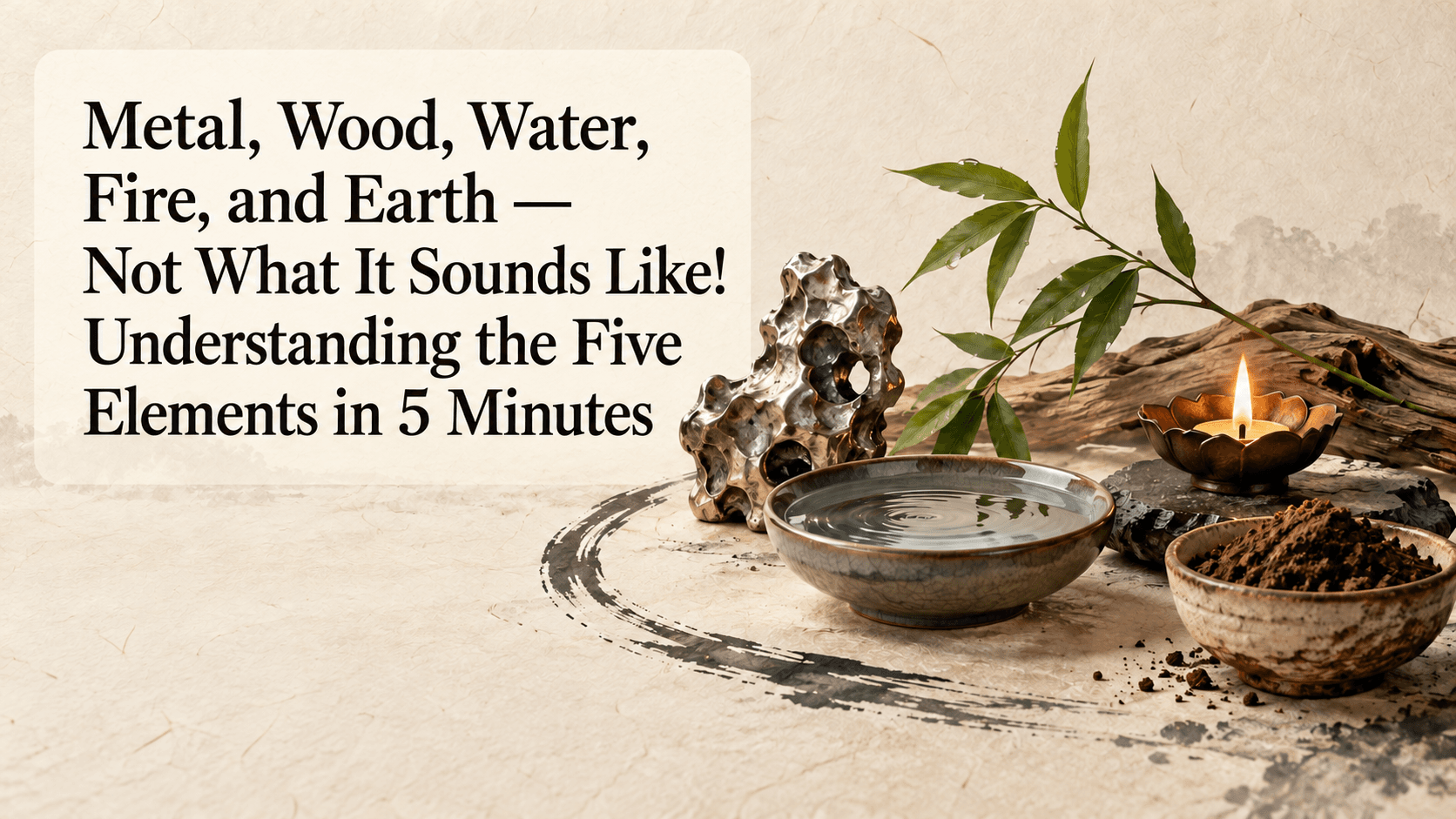
Metal, Wood, Water, Fire, and Earth — Not What It Sounds Like! Understanding the Five Elements in 5 Minutes
Metal, wood, water, fire, earth——It’s not just a list of materials from a hardware store! The true meaning of the Five Elements is five “forms of energy”: wood represents growth, fire represents ascent, earth represents support, metal represents restraint, and water represents flow. Understand the characteristics of metal, wood, water, fire, and earth in 5 minutes and decode the secrets of the Five Elements in Chinese names.
📝 TL;DR Summary
When Chinese people refer to the Five Elements (wǔxíng, the Five Elements/Phases)—Metal, Wood, Water, Fire, and Earth—they might sound like a list of items on a hardware store shelf. In reality, they represent five distinct states of energy. Wood embodies the energy of “growth and expansion,” Fire represents the energy of “ascension and illumination,” Earth corresponds to the energy of “support and stability,” Metal signifies the energy of “concentration and cohesion,” and Water reflects the energy of “flow and adaptability.” Think of them more as verbs than as physical materials. Once you grasp this, it becomes clear why name theory holds that “Metal represents strength, while Water symbolizes wisdom”—each character in a name draws on the inherent qualities of one of these energy states to convey a specific wish or blessing.
I. A Beautiful Misunderstanding at the Hardware Store Entrance
Imagine a Western friend hearing about the Five Elements for the first time: Metal, Wood, Water, Fire, Earth. Immediately, an image of shelves pops into his mind—a section for metal goods, one for wood, another for plumbing supplies... He thinks to himself, “I’m familiar with this list; I have it in my basement.”
This misunderstanding is understandable—translating the Five Elements as five nouns actually misses out on half of their fascinating appeal.
In fact, English already uses terms related to “materials” to describe “states of energy.” People with fiery tempers are described as having a fiery temper (an extremely hot-tempered personality), even though there’s no fire physically present. Those who remain calm under pressure are said to be grounded (steady and unshaken, like being firmly rooted), despite no earth beneath their feet. People with strong willpower are described as having an iron will (a steel-like determination), even though they’re not holding any iron in their hands. And the phrase go with the flow doesn’t mean you should jump into a river.
As you can see, English speakers use “names of materials” to talk about “states of energy” every day. The Five Elements do exactly the same thing—they simply organize these five common metaphors into a systematic “vocabulary of energy.”
So, in one sentence, the analogy in this article is clear: The Five Elements = five forms of energy. Metal, Wood, Water, Fire, and Earth aren’t just items on shelves; they represent five ways energy can manifest—how it grows, burns, endures, withdraws, and flows.
II. Five Types of Energy, Five Ways of “Moving”
Is the concept of “energy forms” my own invention, or was it the original intention of ancient scholars? Let the classics speak for themselves. Fang Lichen describes in detail the “characteristics” of the five elements in Zhengming Daoxing:
“‘Wood’ has the characteristics of growth and straightness; it represents benevolence, with a straightforward nature and gentle emotions. ‘Fire’ has the characteristics of heat generation and upward movement; it represents propriety, with an impatient nature and passionate emotions. ‘Earth’ has the characteristics of nurturing and gestation; it represents trustworthiness, with a steady nature and generous emotions. ‘Metal’ has the characteristics of calmness and restraint; it represents righteousness, with a firm nature and intense emotions. ‘Water’ has the characteristics of coolness and downward flow; it represents wisdom, with a sharp mind and kind emotions.”
—— Fang Lichen, Zhengming Daoxing, Civil Aviation Press of China, 2007In simpler terms: The energy of wood grows straight upward like spring buds; the energy of fire rises, emitting light and heat; the energy of earth supports and nurtures all things; the energy of metal pulls things together, making them solid and sharp; the energy of water flows coolly downward, adapting to its surroundings.
Keep in mind these key terms: growth, upward movement, nurturing, restraint, downward flow—none of which refer to materials as nouns, but rather verbs and directions. From beginning to end, the ancient description of the five elements focuses on how energy “moves.”
Presented in a table, what material-based explanations cannot clarify becomes clear once we consider their energy forms:
| Element | Literal Meaning (in dictionaries) | As an Energy Form (its true “way of moving”) | Personality Trait (Confucian Five Constants) |
|---|---|---|---|
| Wood | Trees, timber | Growth, expansion, upward and outward movement | Represents benevolence (rén, compassion) |
| Fire | Flames | Rising, emitting light and heat | Represents propriety (lǐ, etiquette) |
| Earth | Soil, land | Supporting, stabilizing, nurturing | Represents trustworthiness (xìn, honesty) |
| Metal | Metals, gold | Retracting, condensing, becoming hard and sharp | Represents righteousness (yì, integrity) |
| Water | Water | Flowing, penetrating, adapting to circumstances | Represents wisdom (zhì, insight) |
- Element
- Wood
- Literal Meaning (in dictionaries)
- Trees, timber
- As an Energy Form (its true “way of moving”)
- Growth, expansion, upward and outward movement
- Personality Trait (Confucian Five Constants)
- Represents benevolence (rén, compassion)
- Element
- Fire
- Literal Meaning (in dictionaries)
- Flames
- As an Energy Form (its true “way of moving”)
- Rising, emitting light and heat
- Personality Trait (Confucian Five Constants)
- Represents propriety (lǐ, etiquette)
- Element
- Earth
- Literal Meaning (in dictionaries)
- Soil, land
- As an Energy Form (its true “way of moving”)
- Supporting, stabilizing, nurturing
- Personality Trait (Confucian Five Constants)
- Represents trustworthiness (xìn, honesty)
- Element
- Metal
- Literal Meaning (in dictionaries)
- Metals, gold
- As an Energy Form (its true “way of moving”)
- Retracting, condensing, becoming hard and sharp
- Personality Trait (Confucian Five Constants)
- Represents righteousness (yì, integrity)
- Element
- Water
- Literal Meaning (in dictionaries)
- Water
- As an Energy Form (its true “way of moving”)
- Flowing, penetrating, adapting to circumstances
- Personality Trait (Confucian Five Constants)
- Represents wisdom (zhì, insight)
(“Represent” here means “is characterized by this quality.” The Five Constants of benevolence, propriety, trustworthiness, righteousness, and wisdom are exactly those mentioned in Zhengming Daoxing. Details on personality traits come from He Rongzhu’s Textbook of Name Studies, 2012.)
He Rongzhu provides quite specific descriptions of these personality projections:
“Those associated with metal, embodying righteousness... are firm and sharp. They value honesty and loyalty, pay close attention to right and wrong, and emphasize truth and fairness.”
—— He Rongzhu, Textbook of Name Studies, China Materials Publishing House, 2012
Why does “metal” correspond to “righteousness”? From a purely material perspective, it makes no sense. But in terms of energy, it fits perfectly: the way metal moves is by retracting, condensing, and becoming hard—it shapes loose materials into something defined and unyielding. And “righteousness” embodies exactly this quality—drawing clear lines between right and wrong and keeping one’s word at all costs. The English phrase an iron will uses a similar metaphor: it likens the “hardness” of metal to an unbreakable will.
Why does “water” correspond to “wisdom”? Because water moves by flowing, penetrating, and adapting to its surroundings—it finds a way around obstacles. The great wisdom revered by ancient scholars is precisely this kind of flexibility—soft yet unbroken. Phrases like go with the flow and the psychological concept of fluid intelligence both belong to this same metaphorical family.
Consider “wood represents benevolence” as well: A tree’s growth energy reaches straight for light, without competing, while also providing shade—when applied to human character, it reflects He Rongzhu’s description of those associated with wood as being upright, optimistic, and kind-hearted.
In short: The theory of the five elements is not about “the world being made up of these five things,” but rather that “energy moves in these five ways.” Nouns are just labels; verbs are what truly matter.
III. Returning to Chinese Names: Every Character Carries Its Own Energy
Once you understand that “the Five Elements = forms of energy,” many aspects of choosing Chinese names become much clearer.
Traditionally, Chinese characters are also categorized into the Five Elements—each character carries an inherent energy quality. 正名道姓 provides straightforward guidelines for making such judgments: characters containing “木” generally belong to wood (e.g., 榕, 芸, 竺), those with “氵” tend to relate to water (e.g., 浩, 海, 雪), those with “钅” are typically associated with metal (e.g., 钦, 刚, 剑), characters with “日” or “火” pertain to fire (e.g., 灿, 明), and those with “土” or “山” relate to earth (e.g., 圣, 峰). The “氵” and “钅” here refer to what we call character radicals.
Thus, when parents choose a character for their child’s name, they are not selecting just strokes but rather an energy-based personality trait:
- Choosing 浩 (hào) brings the openness and adaptability of water, hoping the child will have a broad mind and the ability to bend without breaking;
- Choosing 楠 (nán) infuses the vitality and resilience of wood, wishing the child to grow upright and steadily forward;
- Choosing 刚 (gāng) imparts the decisiveness of metal, aiming for a child who can discern right from wrong and keep his promises.
A name is essentially a wish expressed through the language of the Five Elements. As for how these five energies nourish and balance one another—what we refer to as 相生相克, xiāngshēng xiāngkè—Series 4.1 and 4.3 explain this concept clearly using an “food chain” analogy. Topics related to which energy is lacking in a person’s birth 八字 (bāzì, one's birth-time "energy profile") and how names can compensate for it are covered in Series 4.6.
IV. Back to Reality: Where Is This Energy Framework Used?
By adopting the perspective of “energy forms,” you’ll be able to recognize the Five Elements in many everyday Chinese contexts:
Scene 1: The Five-Element Fists in Martial Arts. Xíngyì quán, a Chinese martial art centered around five core striking techniques, features a classic set of “Five-Element Fists”: the chopping fist corresponds to metal, the punching fist to wood, the drilling fist to water, the explosive fist to fire, and the horizontal fist to earth. While practitioners focus on the specific movements, they are actually embodying five distinct ways of channeling energy—chopping should be as decisive as a metal axe falling, while punching should surge upward like a tree breaking through soil. What masters teach isn’t just about metals or wood, but rather the personality traits associated with each type of energy flow.
Scene 2: The Connection Between Internal Organs and the Five Elements in Traditional Chinese Medicine. Zhengming Daoxing documents a well-known correspondence: “Humans have five internal organs—liver, heart, spleen, lungs, and kidneys... The liver, associated with east, green color, and kindness, belongs to wood; the heart, linked to south, red color, and propriety, belongs to fire...” Thus, when TCM speaks of “excessive liver fire,” it doesn’t mean the liver is actually on fire. Instead, it refers to the energy of the liver (belonging to wood) exhibiting characteristics similar to fire—rising sharply and causing restlessness, which can manifest as irritability or a flushed face.
Scene 3: The Casual Remark “Your Five Elements Lack Water” in Conversations. Chinese friends might jokingly say, “You’re too rigid—your Five Elements lack water!” This means you have insufficient “water energy,” lacking flexibility and adaptability. Some people take it seriously, however. Fang Lìchén has noted that many choose to change their names based on Five-Elements theory as adults, aiming to “balance deficiencies such as a lack of water or wood” (Fang Lìchén, Zhengming Daoxing, 2007).
💡 Cultural Note: The Five Elements represent traditional wisdom that has been passed down for over two thousand years—a symbolic system used to classify all things through “energy forms,” rather than a modern chemical theory of elements. Ancient Western cultures also used theories of the four humors (such as sanguine and choleric) to describe personality traits. These are different frameworks, but neither is inherently “correcter” than the other.
V. Practical Tips for You
There’s no need to memorize theories—just focus on these three steps:
-
Think of each character in your name as an “energy pattern.” When you see the radical “氵,” think of flow and adaptability; when you see “木,” think of growth and integrity. Check which element each character in your Chinese name belongs to—that serves as your personal “energy label.”
-
Translate any sense of “deficiency” into terms related to personality first. A lack of “water” doesn’t mean a shortage of H₂O; rather, it indicates a deficiency in flexibility within your energy balance. Viewing it as a metaphor for harmony makes it much easier to understand.
-
Choose characters based on their symbolic meanings. If you desire vitality, opt for characters related to the “wood” element; if you want stability, go for those tied to the “earth” element; and if you seek wisdom and adaptability, choose characters from the “water” element—each radical represents a wish you can incorporate into your name.
Looking to find names that truly resonate with your energy? Give GetHanName a try—just let us know the elemental qualities you’re seeking (such as “wisdom associated with water” or “integrity linked to wood”), and we’ll craft a Chinese name that matches both meaning and energy.
VI. Frequently Asked Questions (FAQ)
Q1: Do the Five Phases really refer to metal, wood, water, fire, and earth?
Not exactly. These five terms are merely names borrowed from common objects; they actually represent five different forms of energy: growth (wood), expansion (fire), support (earth), contraction (metal), and flow (water). For this reason, many scholars advocate translating wuxing as Five Phases—the focus is on “how these energies operate,” not on “what they are.”
Q2: Which phase do I belong to?
According to tradition, it depends on your Ba Zi—the combination of heavenly stems and earthly branches derived from your birth year, month, day, and hour. Each element in this sequence corresponds to one of the Five Phases, collectively forming what can be seen as your “energy profile” (see Section 4.6 for how it’s calculated). A simpler way to determine this is by looking at which phase the heavenly stem or earthly branch of your birth year belongs to.
Q3: Can a person belong to multiple phases at once?
Almost everyone is a “mix.” Since Ba Zi consists of eight characters, each associated with one of the Five Phases, your energy profile usually includes several types of energy in varying proportions—more like a weather forecast (indicating degrees of sunshine, cloudy conditions, and humidity) rather than a single-choice question.
Q4: Are the Five Phases scientific?
They are not modern scientific theories but rather an ancient system of traditional wisdom and classification language. Functionally, they are similar to Western concepts like the four humors theory or astrology—used to help people discuss personality and balance through broad categories. Understanding them is key to grasping Chinese way of thinking, though there’s no need to test their validity using scientific standards.
VII. Further Reading
- 📖 The Five Elements: The Eastern Version of the “Periodic Table” (Series 4.1) — These five forces aren’t isolated entities; learn how they “nurture” one another and “brake” each other through a clear food-chain analogy.
- 📖 Mutual Generation and Restriction: The “Friend Circle” Dynamics Among the Five Elements (Series 4.3) — Discover which elements generate or restrict others, and use this relationship map to understand all the rules governing their interactions.
- 📖 Bazi and Names: Why Your Chinese Name Needs to “Balance” a Certain Element? (Series 4.6) — Find out how your personal “energy balance sheet” is determined based on the time of your birth, and how names can precisely address imbalances.
Reference Sources
- He Rongzhu, Textbook of Name Studies, China Materials Publishing House, 2012.
- Fang Lichen, Zhengming Daoxing, Civil Aviation Press of China, 2007.
This article is original content from the GetHanName blog, first published on gethanname.com. Please contact us if you would like to reproduce it.
Related articles
Xiyongshen: How Traditional Methods Choose Favorable Factors
Understand yongshen, xishen, and jishen through a limited nutrition analogy, and learn why a useful factor is not simply a missing element.
Bazi and Names: How Traditional Naming Uses the Five Phases
Explore character components, generating relationships, and repeated-component characters in naming. Counting missing phases is not a complete method.
What Is Bazi? — Your Birth Time Is a Code
Bazi is not fortune-telling but a “cosmic weather report” at the moment of birth—four pillars (year, month, day, hour) × Heavenly Stems and Earthly Branches = eight characters. Understand in 11 minutes this often-misunderstood “birth code” and why it influences Chinese names.