
Mutual Generation and Restriction: The "Friend Circle" Relationships Among the Five Elements
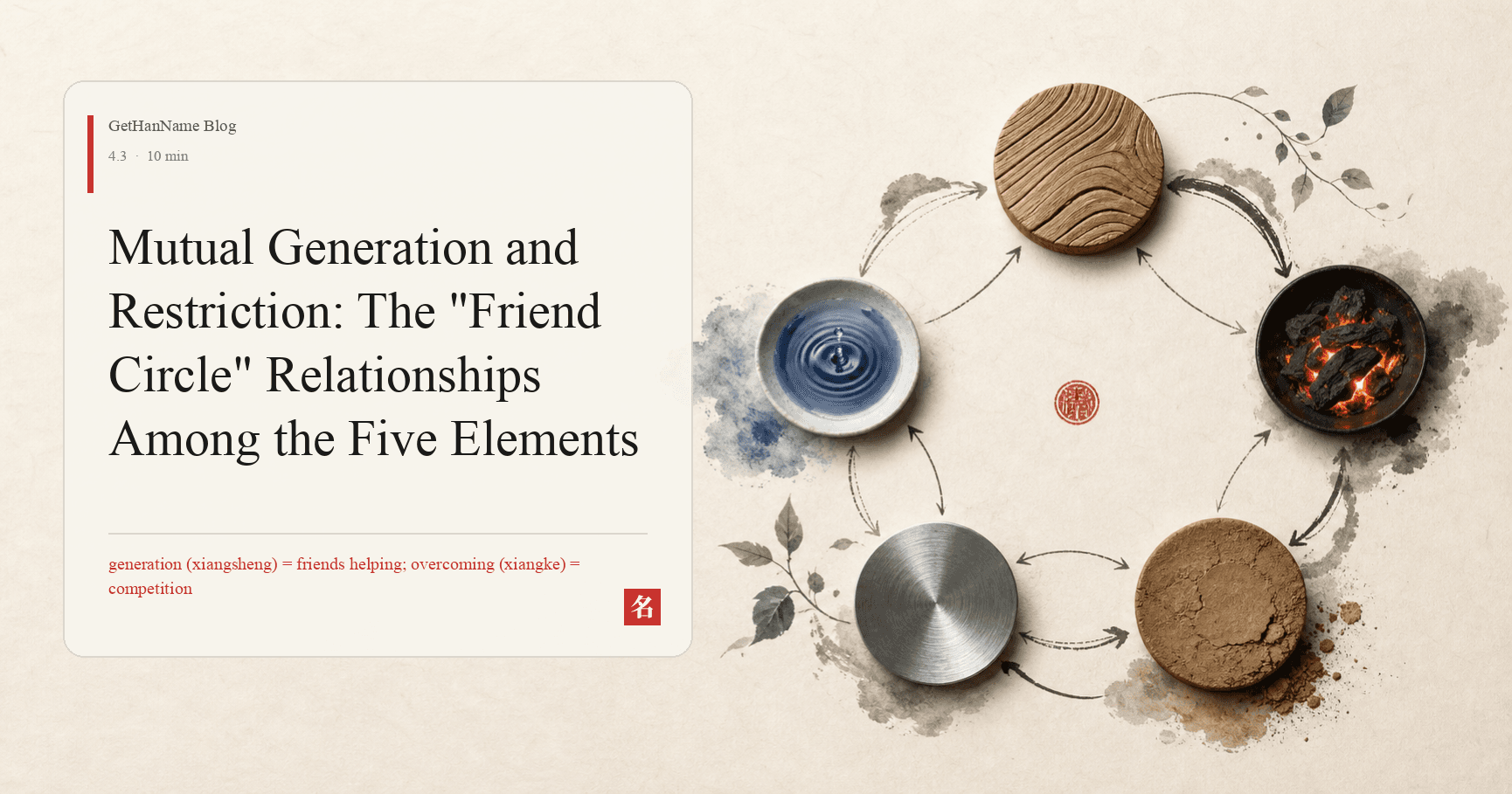
Mutual generation (xiāng shēng) refers to friends helping one another, while mutual restraint (xiāng kè) denotes healthy competition. Using the analogy of social networks, this explains which elements generate or restrain each other among the Five Elements and why this relationship system underpins the “rebalancing the Five Elements” logic in Chinese names.
📝 TL;DR Summary
In Chinese culture, the Five Elements—Metal, Wood, Water, Fire, and Earth—are not five isolated entities acting on their own. Instead, they exist within a fixed network of relationships. This network features two key patterns: mutual generation, where each element “nourishes” the next, and mutual restraint, where each element “balances” another. These concepts represent more like an accelerator and a brake than good versus bad—they are essential for maintaining harmony. By understanding this “Five Elements friend circle,” one can grasp the underlying logic behind using names to “balance” these elements in Chinese naming traditions.
I. Introduction: Every Element Has Friends and Rivals
You’ve probably experienced this before: around certain people, you feel uplifted, believing you can achieve anything; while with others, you feel weighed down—yet you also admit that it is precisely that pressure that drives you to perform more steadily.
No one exists in isolation—everyone is embedded within a web of relationships, filled with those willing to help you and those who compete with you. A healthy relationship network requires both types of people. If there are only helpers, one might become complacent; if there are only rivals, one may collapse.
The Five Elements work in much the same way.
In our previous article, we compared the Five Elements (Metal, Wood, Water, Fire, Earth) to an “Eastern version of the periodic table plus a food chain.” In this article, we’ll delve into the inner workings of that “food chain” to understand how these two types of relationships function—one is called mutual generation, and the other is mutual restraint.
The core analogy here is: the Five Elements ≈ a ‘social relationship network.’ Mutual generation represents friends helping one another, while mutual restraint embodies healthy competition. Once you accept this analogy, those two cycles that confound many Western readers—“Wood generates Fire, Fire generates Earth…” and “Wood restrains Earth, Earth restrains Water…”—become as straightforward to grasp as looking at a friend circle map.
II. Core Analogy: The Two Paths of Friends and Rivals
Let’s start by unfolding that relationship network.
Mutual Generation: The “Mutual Aid Chain” within Friend Circles
Mutual generation (xiāng shēng) refers to one element giving rise to and nurturing another. It forms a continuous chain:
Wood → Fire → Earth → Metal → Water → Wood (returning to the starting point in a cycle)
Each arrow represents an act of offering help:
- Wood generates Fire: Wood provides fuel for fire, allowing it to burn (a friend hands you kindling).
- Fire generates Earth: After burning, ashes return to the earth and turn into soil (a gift left by a friend nourishes you).
- Earth generates Metal: Beneath the soil lie ores and metals (a friend silently builds strength for you).
- Metal generates Water: The cool surface of metal can condense water droplets (a friend brings you a glass of water when you’re most thirsty).
- Water generates Wood: Water moistens trees, helping them sprout anew (a friend helps you grow again).
Notice how this chain isn’t straight but forms a circle—helping one person eventually leads back to helping the original. It mirrors true friendships: you help me, I help him, and after going around the circle, the energy returns to you.
Mutual Restraint: The “Healthy Competition Chain” within Friend Circles
Mutual restraint (xiāng kè) means one element restricts or controls another. This too forms a circle, but the arrows point in entirely different directions:
Wood → Earth → Water → Fire → Metal → Wood
Each arrow represents an act of putting brakes:
- Wood restrains Earth: Tree roots break through the soil to prevent erosion (a teammate stops you from going too far).
- Earth restrains Water: Dikes hold back floods, stopping them from overflowing (a teammate holds the line for you).
- Water restrains Fire: Water extinguishes fire, preventing it from getting out of control (a teammate throws cold water on you at a critical moment).
- Fire restrains Metal: Heat melts metal, shaping rough ores into useful objects (a teammate “forces” you into shape).
- Metal restrains Wood: Metal tools trim trees, helping them grow more neatly (a teammate cuts away excess branches for you).
It’s important to dispel a common misconception: “Restraint” does not mean destruction, hostility, or something negative. It’s more like pruning, braking, or limiting—essential tension that prevents energy from expanding uncontrollably.
Putting the Two Tables Together
| Relationship | Cycle Direction | Analogy | Meaning in Naming |
|---|---|---|---|
| Mutual generation (mutual generation) | Wood→Fire→Earth→Metal→Water→Wood | Friends helping each other: each element feeds the next | When a certain element in the eight-character formula is weak, choose a character that can nurture it (e.g., if wood is weak, use water to generate wood). |
| Mutual restraint (mutual restraint) | Wood→Earth→Water→Fire→Metal→Wood | Healthy competition: each element controls another | When a certain element in the eight-character formula is excessive, choose a character that can restrain it (e.g., if fire is too strong, use water to restrain fire). |
- Relationship
- Mutual generation (mutual generation)
- Cycle Direction
- Wood→Fire→Earth→Metal→Water→Wood
- Analogy
- Friends helping each other: each element feeds the next
- Meaning in Naming
- When a certain element in the eight-character formula is weak, choose a character that can nurture it (e.g., if wood is weak, use water to generate wood).
- Relationship
- Mutual restraint (mutual restraint)
- Cycle Direction
- Wood→Earth→Water→Fire→Metal→Wood
- Analogy
- Healthy competition: each element controls another
- Meaning in Naming
- When a certain element in the eight-character formula is excessive, choose a character that can restrain it (e.g., if fire is too strong, use water to restrain fire).
Why Both Paths Are Necessary
What happens if there are only friends and no rivals? People become complacent—without anyone to brake them, confidence turns into arrogance. What about having only rivals and no friends? People collapse—without support, pressure can break them.
The same holds true for the Five Elements. Without mutual restraint, energy would keep expanding uncontrollably; without mutual generation, energy would waste itself and run out. A healthy system requires both paths to exist simultaneously.
This idea is clearly explained in Zi Ping Zhen Quan, a classic Qing dynasty text on numerology—it doesn’t use the terms “friends and rivals,” but conveys the same meaning:
“Restraint serves to moderate and stop things, allowing them to consolidate so they can be released again... Just as people need food to sustain life, if they eat constantly without letting themselves feel slightly hungry for later, how could they live long?”
— Shen Xiaozhan, Zi Ping Zhen Quan(In plain terms: “Restraint” controls and channels energy so it can be reused later. Just like eating is essential for life, but if one eats nonstop without ever feeling hungry, how could they live long?)
Put another way: Mutual generation is like eating, while mutual restraint is like dieting. Everyone knows that eating endlessly leads to trouble—same principle applies here too. So we say that mutual restraint isn’t an “enemy,” but rather “the friend who stops you before you lose control.”
III. Returning to Chinese Names: Supplementing the Five Elements Means Nurturing This Network of Relationships
So what’s the connection between this “Five Elements Social Circle” and your Chinese name?
The link lies in one word—supplement (bǔ, to add to or make up for).
As discussed in the previous article, the cosmic energy state at the moment of a person’s birth can be recorded using Eight Characters (bāzì), which essentially functions as a “personal profile of elemental energy balances.” Almost everyone has an imbalance—perhaps “fire” is particularly strong while “water” is nearly absent.
Names serve as tools to “supplement” this balance sheet. And exactly how to do so is determined by the principles of mutual generation and restraint:
-
If a certain element is “weak”—use generation to strengthen it. For example, if fire is weak—since wood generates fire—parents might include a character associated with wood in the name, allowing “wood” to gently nourish “fire.” It’s like assigning someone who is not strong enough a partner willing to support them.
-
If a certain element is “strong”—use restraint to balance it. If fire is too strong and prone to getting out of control—because water restrains fire—parents might include a character associated with water in the name, using “water” to act as a brake on “fire.” It’s similar to pairing an overly aggressive friend with a teammate who dares to cool things down.
Textbooks on name studies explain this logic clearly—they even directly use the terms “generation” and “restraint” to assess whether a name is good or not:
“A so-called ‘good name’ is one in which the Heavenly Grid and Earthly Grid ‘generate’ the Personal Grid; conversely, a ‘bad name’ is one in which they ‘restrain’ it.”
—— He Rongzhu, Textbook of Name Studies, China Materials Publishing House, 2012In simpler terms: From the perspective of certain schools of traditional name studies, whether a name is “good” or “bad” essentially depends on whether there is a relationship of mutual generation (support) or restraint (conflict) among the various elemental components within the name.
That’s why characters like Han, Run, Ze—which contain the water radical—and Sen, Lin, Tong—which contain the wood radical—as well as Yan, Yu, Ye—which contain the fire radical—are not just “attractive-looking characters.” Each one is a deliberate choice by parents to include in this “network of relationships” within the name, aiming to create a harmonious balance with the existing elemental energies reflected in the Eight Characters.
In short: A name isn’t an isolated label slapped on someone—it’s a new member joining your “Five Elements Social Circle.” It either helps support certain elements or acts as a counterweight to others.
IV. Back to Reality: How This “Network of Relationships” Mindset Influences Chinese People
Once you grasp this perspective, many previously confusing aspects of Chinese naming traditions become much clearer and more logical:
Scenario 1: Parents Choose Characters with “Water” Elements to Counteract Excessive “Fire.”
If a couple determines that their child’s birth chart features an overly strong “fire” element, they worry the child might grow up to be impulsive or hot-tempered. Instead of adding more fire, they deliberately select characters like 淼 (miǎo, vast water), 涵 (hán, to contain), and 润 (rùn, moisten)—all associated with water. To them, this isn’t just a matter of aesthetic preference; it’s about pairing “fire” with a “water friend” to prevent it from becoming too intense—essentially using the principle of mutual restraint.
Scenario 2: Avoiding Combinations That Cause Conflict Between Opposing Elements.
If a child’s surname already belongs to the “metal” element, some families instinctively avoid characters related to “wood,” given that metal overcomes wood. They don’t want the child’s name to represent internal conflict. Of course, this is just one approach—other parents may actually value the corrective effect of such opposition, highlighting how open and diverse this wisdom truly is.
Scenario 3: Adults Changing Their Names Because Certain Characters Are in Conflict.
Some people face continuous setbacks in adulthood and consult experts about their names. If they’re told that the five elements in their name are conflicting and causing internal strife, they might seriously consider changing to a name with more harmonious relationships. In their view, it’s like reorganizing a team that’s constantly fighting among itself—they don’t expect a name change to instantly solve all problems, but rather believe that the symbols we speak and write every day should represent a relationship of support, not one of disruption.
💡 Cultural Note: What’s described here reflects the attitudes and practices of many Chinese families regarding the relationships between the five elements—not an assertion that these relationships are scientifically proven physical laws. It’s more like a set of traditional wisdom passed down for thousands of years, used to reflect on balance and harmony, much like how Westerners use astrology to discuss personality traits. Understanding it is key to unlocking Eastern ways of thinking, not as absolute truths to be accepted uncritically.
V. Practical Tips for You
After reading this, you don’t need to memorize those cycles of mutual generation and restraint, but keeping these points in mind will give you a deeper understanding of Chinese names:
-
Think of the characters in your name as a “small team.” Consider which elemental category each character generally falls into (characters with water radicals tend to relate to water, those with wood radicals to wood, and those with fire/sun radicals to fire). Then ask yourself: Do these elements tend to support one another, or do they often clash? A team that lifts each other up sounds far more reassuring than one that works against one another.
-
Don’t panic at the sight of “restraint” elements. Mutual restraint doesn’t necessarily mean something negative. As stated in Zi Ping Zhen Quan, the role of restraint is to “moderate and bring things under control.” Sometimes, just the right amount of restraint can act as a guiding force that helps you get back on track. The key isn’t whether there’s any restraint at all, but rather whether the overall combination is harmonious.
-
There’s no need to aim for “all five elements.” A great name doesn’t have to include all five elements of metal, wood, water, fire, and earth—just as a good friend doesn’t need to know everyone with different personalities. What matters most is whether the relationships between the elements are balanced, not whether every element is present.
Looking for a Chinese name that truly “fits” you? Give GetHanName a try—we’ll take into account your preferences regarding the five elements (for example, using water to balance excessive fire or wood to nurture weaker fire) to create a name that is not only meaningful but also features harmonious elemental relationships.
6. Frequently Asked Questions (FAQ)
Q1: Is mutual restraint necessarily bad?
Not necessarily. In the theory of the Five Elements, “restraint” refers more to “guiding and shaping” rather than “eradicating.” An unpruned forest grows untidy, just as an uncontrolled energy becomes chaotic. The saying from Zi Ping Zhen Quan—“Generation and restraint serve the same purpose; restraint and generation achieve the same outcome”—exactly captures this idea: both are essential components of a balanced system.
Q2: Can my name include all five elements?
It’s possible, but it’s not necessary. Most Chinese names consist of just two or three characters, so forcing in all five elements is neither practical nor always harmonious. What matters most is dynamic balance, not simply having all five elements present. Even if a name emphasizes only one or two elements, as long as they are well-balanced, it remains a good name.
Q3: What if the characters in my name all mutually restrain each other?
There’s no need to panic right away. The impact of mutual restraint depends on the overall strength contrast and the position of those elements—just as “water restrains fire,” if fire is extremely strong, it may actually benefit from some water to maintain balance; if fire is already weak, that same restraint might be too much. To determine this accurately, one needs to analyze the overall pattern of a person’s birth chart. We’ll go into more detail about birth charts in future articles.
Q4: How can I figure out which element is strong and which is weak in my birth chart?
The most straightforward way is to examine your birth chart (the Heavenly Stems and Earthly Branches derived from your date of birth). Count the elements corresponding to each of the eight characters to see which one appears more often and which is less so. However, getting an accurate reading requires not only calculation but also an understanding of the overall pattern, usually involving specialized tools or consultation with an expert.
Q5: I keep mixing up the directions of mutual generation and restraint—what should I do?
Memorizing a simple, intuitive example will help: Wood generates Fire (as in starting a fire by drilling wood, something everyone knows), and Water restrains Fire (as in using water to put out fires, also common knowledge). You can deduce the other four pairs by following this “cyclical” logic—there’s no need to memorize them by rote. The key is to understand that “generation” implies mutual support while “restraint” means guidance and control, rather than simply recalling the sequence backward.
VII. Further Reading
- 📖 The Five Elements: The Eastern Version of the "Periodic Table" (Series 4.1) — If you’re still unsure about what the Five Elements are, start here first. This article builds on the concepts of a “periodic table” and food chains and serves as the foundation for the rest of this series.
- 📖 What Are Bazi? How Your Birth Time Becomes an "Energy Report" (Series 4.4) — If you want to truly understand which elements in your life are strong and which are weak, understanding Bazi is a essential step.
- 📖 Bazi and Names: How Exactly Do We Balance Deficiencies with the Five Elements? (Series 4.6) — This piece connects the logic of mutual generation and restraint discussed earlier with the concept of “preferred elements” in Bazi, showing how a specific name is crafted accordingly.
References
- Shen Xiaozhan, Zi Ping Zhen Quan (a classic work on fortune-telling from the Qing dynasty). The passage cited here, “Those that restrain serve to moderate and stop...”, comes from the chapter “On the Generation and Restraint of Yin and Yang” in this book.
- He Rongzhu, Textbook of Name Studies, China Materials Publishing House, 2012. The criteria for “good names/bad names” referenced here are drawn from the book’s summary of the naming theories of the Three Talents School and the Five Grids School.
- The original text from Zi Ping Zhen Quan cited in this article is written in classical Chinese, with modern translations provided at each citation for easier understanding.
This article is an original creation for the GetHanName blog, first published on gethanname.com. Please contact us if you would like to reproduce it.
Related articles
What Is Bazi? — Your Birth Time Is a Code
Bazi is not fortune-telling but a “cosmic weather report” at the moment of birth—four pillars (year, month, day, hour) × Heavenly Stems and Earthly Branches = eight characters. Understand in 11 minutes this often-misunderstood “birth code” and why it influences Chinese names.
The Five Elements: The Eastern Version of the “Periodic Table”
The Wuxing is not five static substances but five cyclic stages of energy. Use the analogy of “periodic table + food chain” to explain how metal, wood, water, fire, and earth interact in a cycle of support and restraint, and why it influences Chinese names. Lesson 1: Getting started with naming using Wuxing.