
The Five Elements: The Eastern Version of the “Periodic Table”
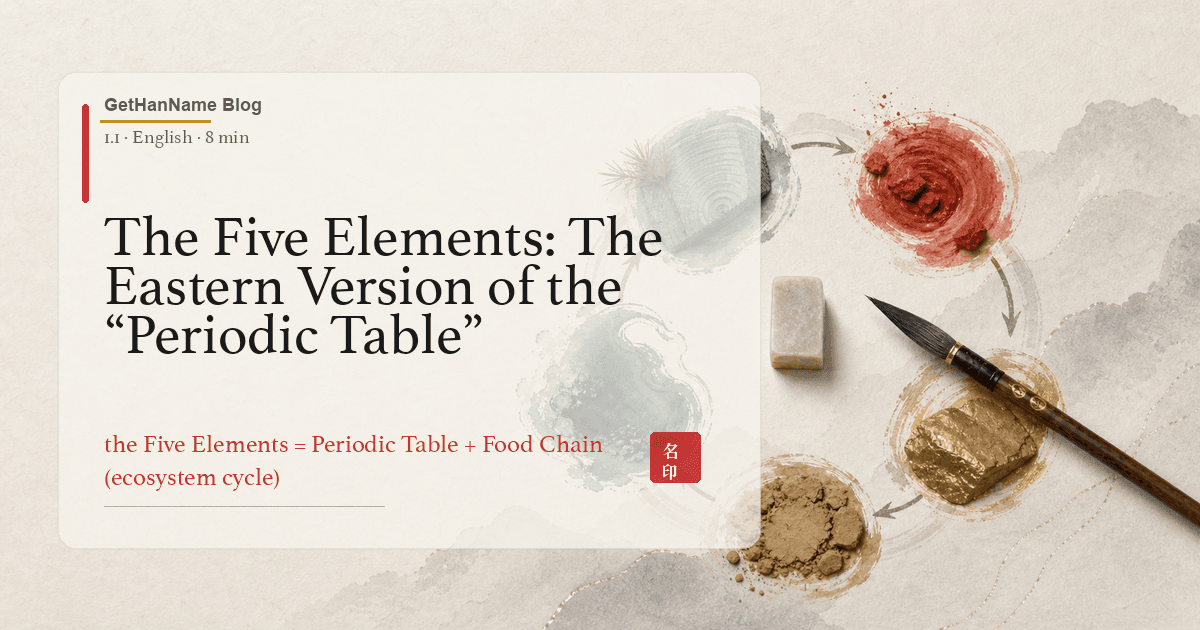
The Wuxing is not five static substances but five cyclic stages of energy. Use the analogy of “periodic table + food chain” to explain how metal, wood, water, fire, and earth interact in a cycle of support and restraint, and why it influences Chinese names. Lesson 1: Getting started with naming using Wuxing.
📝 TL;DR
In Chinese culture, the Five Elements (wǔxíng)—Metal, Wood, Water, Fire, and Earth—are not five static materials but rather five dynamic energy phases that continuously flow, nourish one another, and maintain balance. Think of it as a blend of a “periodic table” and a “food chain”: just as the periodic table organizes the fundamental “building blocks” of the world, this system mirrors an ecosystem where these elements interact through consumption and creation. In just 9 minutes, this article will help you understand this ancient framework, which confuses many Westerners yet is embedded in every Chinese name.
1. Starting with a List You Might Be Familiar With
If you’ve studied Western philosophy or the history of chemistry, you’re likely familiar with the ancient Greeks’ “Four Elements”: Earth, Air, Fire, Water. Aristotle believed that all things are composed of these four fundamental substances.
This was the West’s earliest attempt to answer the question: What makes up the world?
In China, around the same time—or even earlier—thinkers offered a different answer: not four elements, but five; and their way of functioning is entirely distinct from the Greek model.
Many Western friends, upon first hearing about Metal, Wood, Water, Fire, Earth, instinctively equate them with the Greek Four Elements, thinking, “Oh, you’re also using a few basic substances to explain the world.”
This intuition is only half correct.
China’s Five Elements does indeed serve as a list for classifying the fundamental components of the world—but it goes far beyond that. It functions more like a dynamic system: these “components” nourish and restrain one another, creating an endless ecological cycle.
So, the analogy we’d like you to keep in mind is: Five Elements ≈ Periodic Table + Food Chain. It serves both a classifying function and a cyclical one. Only by grasping these two aspects can you truly understand the essence of the Five Elements.
II. Core Analogy: The Periodic Table + Food Chain
Let’s start with the first layer — the layer inspired by the periodic table.
The Five Elements categorize the “underlying energy” of all things in the universe into five major groups:
| Element | Pinyin | What It Represents | Corresponding Personality Traits (as inferred from name studies) |
|---|---|---|---|
| Wood | mù | Growth, expansion, vitality | Emphasizes benevolence — integrity, optimism, and a strong family focus |
| Fire | huǒ | Ascension, passion, brightness | Emphasizes propriety — enthusiasm, openness, and honesty |
| Earth | tǔ | Support, stability, inclusiveness | Emphasizes faithfulness — composure, tolerance, and empathy |
| Metal | jīn | Restraint, sharpness, restraint | Emphasizes righteousness — reliability, a strong sense of right and wrong |
| Water | shuǐ | Flow, downward movement, wisdom | Emphasizes intelligence — quick thinking, adaptability |
- Element
- Wood
- Pinyin
- mù
- What It Represents
- Growth, expansion, vitality
- Corresponding Personality Traits (as inferred from name studies)
- Emphasizes benevolence — integrity, optimism, and a strong family focus
- Element
- Fire
- Pinyin
- huǒ
- What It Represents
- Ascension, passion, brightness
- Corresponding Personality Traits (as inferred from name studies)
- Emphasizes propriety — enthusiasm, openness, and honesty
- Element
- Earth
- Pinyin
- tǔ
- What It Represents
- Support, stability, inclusiveness
- Corresponding Personality Traits (as inferred from name studies)
- Emphasizes faithfulness — composure, tolerance, and empathy
- Element
- Metal
- Pinyin
- jīn
- What It Represents
- Restraint, sharpness, restraint
- Corresponding Personality Traits (as inferred from name studies)
- Emphasizes righteousness — reliability, a strong sense of right and wrong
- Element
- Water
- Pinyin
- shuǐ
- What It Represents
- Flow, downward movement, wisdom
- Corresponding Personality Traits (as inferred from name studies)
- Emphasizes intelligence — quick thinking, adaptability
Note: The third column, “Personality Traits,” comes from a textbook on name studies (He Rongzhu, Textbook of Name Studies, China Materials Publishing House, 2012). It reflects the ancient tradition of extending the attributes of the Five Elements to human temperament.
At this point, it indeed resembles an “Oriental version of the periodic table” — categorizing the fundamental “stuff” that makes up the world.
But the key lies in the second layer — the food chain.
The Greek Four Elements are static: Earth is simply Earth, Fire is simply Fire. They exist side by side to constitute all things, with no inherent “who eats whom” relationship between them.
The Five Elements are entirely different. Among these five energies, there exists a fixed “feeding relationship” and a fixed “restraining relationship”:
Generation Cycle (“Who gives birth to whom”) — similar to how one link in a food chain feeds the next:
Wood generates Fire → Fire generates Earth → Earth generates Metal → Metal generates Water → Water generates Wood (returning to Wood, creating a continuous cycle)
Think about it: Wood is ignited by fire (Wood generates Fire), the fire turns into ash that falls back into the soil (Fire generates Earth), the soil contains minerals and metals (Earth generates Metal), the cold surface of metal condenses water droplets (Metal generates Water), and water then nourishes the growth of trees (Water generates Wood). After one full cycle, we’re back where we started.
Restraint Cycle (“Who restrains whom”) — similar to ecological balance, preventing any single energy from growing out of control:
Wood restrains Earth → Earth restrains Water → Water restrains Fire → Fire restrains Metal → Metal restrains Wood
This is equally easy to understand: Tree roots break through the soil (Wood restrains Earth), earth dams hold back floods (Earth restrains Water), water extinguishes fire (Water restrains Fire), fire melts metal (Fire restrains Metal), and metal tools cut down trees (Metal restrains Wood).
Do you notice? Generation and restraint are not “good vs. bad” — they’re more like “feeding vs. braking.” A car with only an accelerator and no brakes will cause accidents, just as a system that only generates energy without any restraint will collapse.
This idea is beautifully expressed in the classic Qing Dynasty text on fate studies, Zi Ping Zhen Quan:
“The cycle of the four seasons depends on mutual generation; thus Wood generates Fire, Fire generates Earth, Earth generates Metal, Metal generates Water, and Water then generates Wood. This is the sequence of generation, cycling endlessly so that time never runs out. Yet, where there is generation, there must also be restraint. Without restraint alongside generation, the cycle of the four seasons cannot sustain itself.”
— Shen Xiaozhan, Zi Ping Zhen Quan(In plain terms: The flow of the four seasons relies on mutual generation, which is why Wood generates Fire, Fire generates Earth, and so on in an endless loop. But generation alone isn’t enough — restraint is necessary to keep things in balance.)
Another insightful quote from the same book adds further clarity:
“Generation and restraint serve the same purpose; restraint has the same effect as generation.”
— Shen Xiaozhan, Zi Ping Zhen Quan(In plain terms: Generation and restraint are equally important, with restraint playing a role similar to that of generation.)
This is the biggest “difference” between the Five Elements and the Greek Four Elements: the Five Elements aren’t five nouns — they’re five verbs. They don’t describe “what something is,” but rather “how it moves and how it influences others.” That’s why some scholars prefer translating them as “Five Phases” rather than “Five Elements” — because at their core, they represent a set of continuous processes, not just static components.
This is also why our core analogy is “periodic table + food chain”: the periodic table handles “classification,” while the food chain represents “cycling.” Without either element, the concept of the Five Elements cannot hold.
III. Returning to Chinese Names: Why “Your Name Needs Certain Elements”?
Alright, now you probably have a basic understanding of the Five Elements as a cyclical energy system. But what does it have to do with Chinese names?
The connection lies in one word—补 (bǔ, to supplement / make up for).
According to traditional Chinese belief, at the exact moment of your birth, the universe’s energy state is unique. This moment can be recorded using 八字 (bāzì, Eight Characters / "Four Pillars of Destiny")—which consists of eight characters representing the year, month, day, and hour of your birth, each paired with a Heavenly Stem and an Earthly Branch. Essentially, the八字 serves as a “personal profile of your Five Elements energy balance.”
Textbooks on name studies put it quite plainly:
“The Eight Characters reflect a person’s innate Five Elements energy. Everyone’s balance of these elements varies... The purpose of selecting appropriate elements is to maintain equilibrium among them.”
—— He Rongzhu, Textbook of Name Studies, China Materials Publishing House, 2012In simpler terms: The Eight Characters show how a person’s Five Elements energy is distributed from birth, and this varies from person to person. “Selecting appropriate elements” means ensuring that these energies stay balanced.
In other words, at birth, everyone has an uneven distribution of the Five Elements. Perhaps your八字 shows “excess fire,” or maybe there’s almost no “water” present.
This is where names come in handy. If your八字 lacks “water,” parents might deliberately choose a character with a water radical or one whose meaning relates to water to 补 that deficiency. An example given in textbooks reads:
“Use elements that generate each other to support weaker ones. For instance, if wood is weak—since water generates wood—it’s appropriate to use water to strengthen it.”
—— He Rongzhu, Textbook of Name Studies, China Materials Publishing House, 2012In simpler terms: If one element is weak, use another element that can “generate” it to give it a boost. For example, if wood is weak because water nurtures it, adding “water” helps strengthen the wood.
Think of it like this: Your Five Elements energy is akin to the soil composition in a potted plant. If the balance of nitrogen, phosphorus, and potassium in that soil is off, the plant won’t thrive. Since you can’t choose a new piece of soil (your birth moment is fixed), you can fertilize the plant—and your name acts as that fertilizer. It adds the missing element, helping the previously weak energy regain balance.
This is the simplest logic behind Five Elements naming: Names aren’t just arbitrary labels; they are customized remedies formulated based on the “energy health report” of the moment you were born.
Of course, this practice assumes that Five Elements energy truly exists and influences people. It represents a form of traditional wisdom that has been passed down in China for thousands of years, though not everyone embraces it—something we’ll explore in the final section.
IV. Back to Reality: How This “Five Elements” Concept Influences Daily Life in China
With this logic in mind, you’ll be able to make sense of many seemingly puzzling Chinese cultural practices:
Scenario 1: Parents consult dictionaries and choose characters associated with “water.”
When a couple learns that their child’s birth chart lacks the element of water, they instinctively lean toward characters like 淼 (miǎo, vast water), 涵 (hán, to contain/immerse), 润 (rùn, moisten), and 泽 (zé, pool/marsh)—characters that either contain the water radical or carry meanings related to water. To them, these aren’t just pleasing-sounding choices; they represent a subtle way of “adding water” to their child’s life. Using an analogy from gardening, it’s like watering soil that has become too dry.
Scenario 2: Names tied to “fire” are favored in years associated with fire, and those linked to “metal” in years linked to metal.
A person’s birth year is associated with one of the five elements. According to certain traditional beliefs, if a child is born in a year when fire is particularly strong, including more fire-related characters in their name might make that element even stronger than necessary. As a result, some families opt instead for characters belonging to water or earth to create balance. Behind many of the popular names of each year lies this consideration of elemental harmony—even though most parents may not calculate these details precisely, the instinct to avoid disharmony and seek balance is widespread.
Scenario 3: Adults change their names because of “incompatible elements.”
Some people who feel unlucky in life after reaching adulthood seek advice on their names. If they’re told that the elements in their name are incompatible with their birth chart, they might seriously consider changing to a name that better aligns with it. In their view, this is similar to repotting a plant that’s growing poorly—not out of superstition that a name can instantly change fortune, but because they believe names, as symbols repeated daily in speech and writing, should be in harmony with a person’s underlying “energy.”
💡 Cultural Note: Please keep in mind that what’s described here are the attitudes and practices of many Chinese families toward the five elements, not an assertion that they represent scientifically proven physical laws. It is more like a set of traditional wisdom and symbolic systems that have endured for thousands of years—tools people use to reflect on balance, much like how Westerners refer to astrology when discussing personality. Understanding it is a key to grasping Eastern ways of thinking, not something that needs to be accepted as absolute truth.
V. Practical Tips for You
After reading this, you don’t need to memorize those cycles of mutual generation and restraint, nor do you have to learn how to calculate birth dates based on the eight trigrams. Yet there are a few key points that can deepen your understanding of a Chinese name:
-
Knowing which “element” your name belongs to adds another layer of meaning. Many Chinese characters inherently carry五行 attributes—those with the “wood” radical usually relate to wood, while those with “fire” or “sun” tend to correspond to fire, and those with “earth” or “mountain” are often tied to earth. Next time you see your Chinese name, try guessing its elemental type, just as you would read a nutrition label.
-
There’s no need to pursue perfect balance. The concept of五行 emphasizes dynamic equilibrium, not having all five elements represented. Even if a name highlights only one or two elements, as long as it harmonizes with the individual, it is still a good name. It’s similar to fertilizing—there’s no need to apply every nutrient at once; what matters most is addressing the specific needs.
-
View五行 as a “wish-fulfilling language,” not just a formula. When Chinese parents choose characters associated with water, they are essentially expressing the wish that their child may be as gentle, nurturing, and agile as water. Understanding this symbolic layer transforms how you perceive Chinese names—they are not merely symbols but heartfelt blessings expressed through五行.
Looking for a truly “suitable” Chinese name? Feel free to try GetHanName—we don’t just translate your English name; we also consider your preferences regarding五行, such as whether you’d like to strengthen “water” or embrace the vitality of “wood,” to create a name that is both meaningful and in harmony with you.
6. Frequently Asked Questions (FAQ)
Q1: Are the Five Elements the same as ancient Greece’s “Four Elements”?
No, they are not. Both attempt to answer the question of “what makes up the world,” which gives them a superficial similarity. However, the Greek Four Elements—earth, air, fire, and water—are static building blocks of matter, whereas China’s Five Elements—metal, wood, water, fire, and earth—are dynamic cycles of energy with fixed relationships of mutual generation (supporting each other) and restriction (balancing one another). One focuses on “what things are,” while the other emphasizes “how they interact.” These are two distinct frameworks, and neither is inherently superior to the other.
Q2: Are the Five Elements science or superstition?
Neither label fits perfectly. They represent a system of traditional wisdom and philosophical framework that has been practiced in China for over two thousand years. Ancient people used them to understand balance in seasons, health, and relationships. While they are not modern scientific laws, nor can they be simply labeled as “superstition”—just as traditional Chinese medicine’s concepts of yin and yang or Western astrology should not be dismissed outright. They function as a symbolic system for understanding the world.
Q3: Do I have to choose a Chinese name that achieves “five-element balance”?
Not at all. The vast majority of people in China do not calculate their birth dates based on the Eight Characters Formula or match names to specific elements when naming children. They prioritize sounds, ease of writing, and positive meanings instead. Using the Five Elements in naming is an advanced option for those who wish to add a deeper cultural layer to their name, but it is by no means a requirement. Ultimately, the best name is one that feels pleasing to you when spoken.
Q4: How can I find out which element I belong to?
The most straightforward way is by examining your Eight Characters Formula, which converts your birth year, month, day, and hour into Heavenly Stems and Earthly Branches. The set corresponding to your birth year within the 60-year cycle carries a dominant Five Elements attribute. However, obtaining an accurate result—and understanding the overall balance—usually requires using specialized tools or consulting someone knowledgeable in this field. We will cover in future articles how the Eight Characters Formula connects to naming in more detail.
Q5: Does “metal restricts wood” mean I can’t use wood if my name includes metal?
Not necessarily. Restriction does not imply “absolute conflict that must be avoided”; rather, it means “one element exerts influence over another.” In many traditional analyses, restriction is actually a means of maintaining balance—just as the saying from Zi Ping Zhen Quan states, “Generation and restriction serve together; restriction and generation achieve the same goal.” So there’s no need to fear restriction; the key is ensuring that the overall combination remains harmonious.
VII. Further Reading
- 📖 A Deep Dive into Metal, Wood, Water, Fire, and Earth: What Do These Elements Represent? —— Curious about why Wood symbolizes kindness and Water represents wisdom? This article breaks down the personality traits and meanings of each of these five elements one by one.
- 📖 Mutual Generation and Restriction: How Do the Five Elements Both “Nurture” and “Brake” One Another? —— We’ll thoroughly explain those two cycles with real-life examples, helping you quickly understand which elements generate or restrict each other.
- 📖 Bazi and Names: How Does Your Time of Birth Influence Your Name? —— What exactly is Bazi? And how does it turn into a kind of “five-elements health report”? This article provides the answers.
References
- Shen Xiaozhan, Zi Ping Zhen Quan (a classic work on fortune-telling from the Qing dynasty).
- He Rongzhu, Textbook of Name Studies, China Materials Publishing House, 2012.
- The original texts from Zi Ping Zhen Quan cited in this article are written in classical Chinese, with modern translations provided alongside them for easier understanding.
This article is an original creation for the GetHanName blog, first published on gethanname.com. Please contact us if you wish to reproduce it.
Related articles
What Is Bazi? — Your Birth Time Is a Code
Bazi is not fortune-telling but a “cosmic weather report” at the moment of birth—four pillars (year, month, day, hour) × Heavenly Stems and Earthly Branches = eight characters. Understand in 11 minutes this often-misunderstood “birth code” and why it influences Chinese names.
Mutual Generation and Restriction: The "Friend Circle" Relationships Among the Five Elements
Mutual generation (xiāng shēng) refers to friends helping one another, while mutual restraint (xiāng kè) denotes healthy competition. Using the analogy of social networks, this explains which elements generate or restrain each other among the Five Elements and why this relationship system underpins the “rebalancing the Five Elements” logic in Chinese names.