
Eastern vs Western Naming: Why Are We So Different?
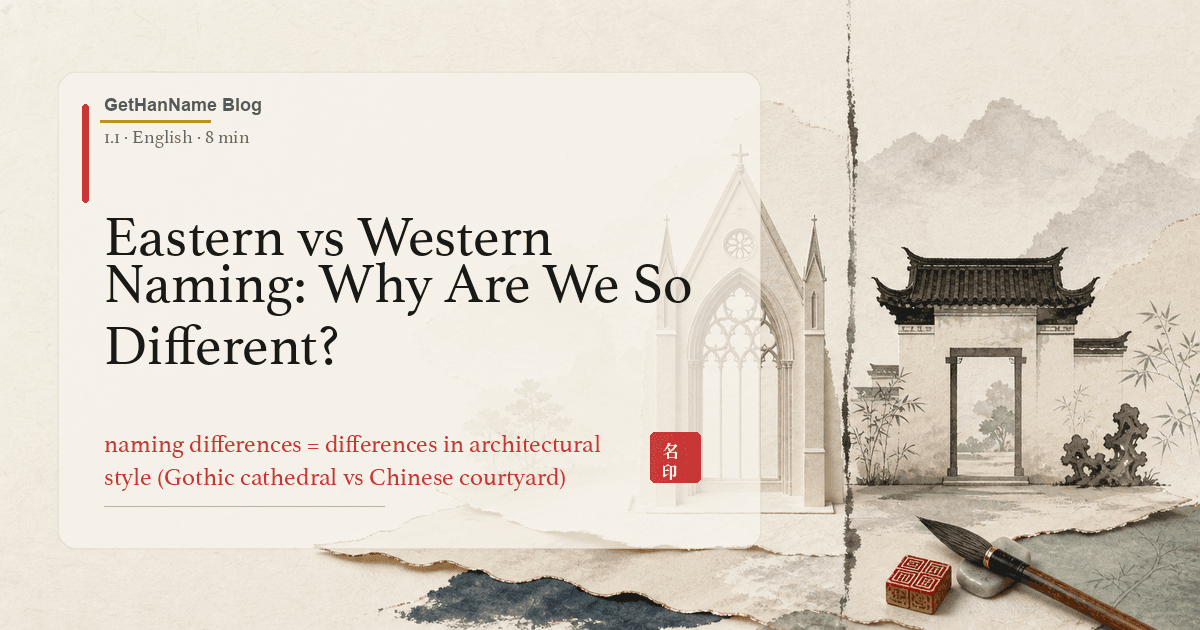
Why Do Chinese People Put Their Surnames First and Have Only Two or Three Characters for Their Names? Explained with an Architectural Analogy: Western naming is like Gothic churches, focusing on the individual; Chinese names are like traditional courtyards, centered around the family. Both traditions are equally remarkable, just different.
📝 TL;DR Summary
The naming traditions of the East and West are like two distinct architectural styles. Western names resemble a Gothic cathedral, with their steep spires reaching toward the sky to emphasize the individual self. Chinese names, on the other hand, are akin to a Chinese courtyard, where houses surround a shared central space, highlighting the family lineage. Both serve the same purpose—establishing identity—but they address different cultural priorities. Neither tradition is inherently superior; the difference lies in their unique approaches, not in which one is better.
I. Two Types of Structures, One Shared Purpose
Imagine two buildings.
One is a European Gothic cathedral: its tall, slender pointed arches and soaring spires stretch powerfully vertically upward, as if striving to lift an individual to heights near those of the gods. Standing inside, you look up at the sky—this creates a sense of verticality that emphasizes the “individual.”
The other is a Chinese sìhéyuàn, traditional Chinese courtyard house: several rooms enclose each other inward, leaving a peaceful courtyard in the center. An entire family lives around this shared space—this fosters a sense of cohesion centered on the “family.”
Both types of structures aim to solve the same problem: providing shelter from the elements. Yet their “solutions” differ greatly—one reaches upward, the other inward. Neither is inherently better; each responds to what matters most in its respective culture.
Interestingly, the ways people in the East and West name their children follow paths that are almost identical. In this article, we’ll use the analogy of architecture to clarify these differences.
II. Expanding Through Core Analogies: Naming as a “Cultural Building”
If naming were a form of architecture, Eastern and Western traditions would construct entirely different kinds of houses.
| Dimension | Western Naming (Gothic Churches) | Chinese Naming (Traditional Courtyards) |
|---|---|---|
| Surname Order | Given name first, surname last (John Smith) — revealing the individual first | Surname first, given name last (Zhang Wei) — introducing one to the family first |
| Name Origin | A shared “name pool” of saints, biblical figures, royalty, etc. (e.g., John, Mary, Michael) | Customized names based on family generational characters, poetic references, or the Five Elements |
| Name Length | Usually longer, emphasizing phonetic combinations (first + middle + last) | Typically 2–4 Chinese characters, short yet meaningful |
| Importance of Names | Focuses primarily on individual identity | Balances family continuity with personal wishes |
- Dimension
- Surname Order
- Western Naming (Gothic Churches)
- Given name first, surname last (John Smith) — revealing the individual first
- Chinese Naming (Traditional Courtyards)
- Surname first, given name last (Zhang Wei) — introducing one to the family first
- Dimension
- Name Origin
- Western Naming (Gothic Churches)
- A shared “name pool” of saints, biblical figures, royalty, etc. (e.g., John, Mary, Michael)
- Chinese Naming (Traditional Courtyards)
- Customized names based on family generational characters, poetic references, or the Five Elements
- Dimension
- Name Length
- Western Naming (Gothic Churches)
- Usually longer, emphasizing phonetic combinations (first + middle + last)
- Chinese Naming (Traditional Courtyards)
- Typically 2–4 Chinese characters, short yet meaningful
- Dimension
- Importance of Names
- Western Naming (Gothic Churches)
- Focuses primarily on individual identity
- Chinese Naming (Traditional Courtyards)
- Balances family continuity with personal wishes
This table serves as the backbone of the entire article. Let’s break it down line by line—both traditions deserve careful attention.
First Line — Surname First or Given Name First? This is often the first difference people notice. In the West, the given name comes first, followed by the surname (John Smith), immediately signaling “this is John.” In China, however, the surname always comes first (Zhang Wei), indicating “he belongs to the Zhang family.” Using the architectural metaphor: Western names make you look up at the towering spire first (the individual as a standalone entity), while Chinese names prompt you to step through the courtyard gate first (the family) before spotting someone inside. The “family” exists before the “person within it.”
Behind this difference lies each culture’s distinct answer to the question of what holds greater importance—not a judgment of superiority or inferiority. Naming scholar Fang Lichen describes this Eastern tradition in his work:
"Since ancient times, people have advocated ‘children continuing their fathers’ careers’ and ‘carrying forward their fathers’ aspirations’... This is starkly different from the West... Children become extensions of their parents’ wills and wishes; unfulfilled goals or dreams of earlier generations are reflected in their children’s names."
— Fang Lichen, Zhèng Míng Dào Xìng – An Authoritative Guide to Chinese Naming, Civil Aviation Press of China, 2007
Note how he uses the word “difference” rather than claiming one approach is right or wrong. This reflects the attitude we aim to convey.
Second Line — Where Do Names Come From? The West has a centuries-old “shared name pool”: figures from the Bible, historical saints, royal members—John, Mary, Elizabeth, Michael. These names function like common building materials that any family can use, with the emphasis on how such classic names confer a sense of legacy to the child.
Chinese naming, on the other hand, is more akin to building brick by brick with care. Parents may choose a character from their family’s generational characters (zìbèi)—siblings in the same generation share the same character, instantly signaling they belong to the same lineage—and then add a unique character for the child, carrying hopes and blessings. Some families also draw inspiration from poetic references or the Five Elements (wǔxíng) when crafting names. One approach is selecting a classic stone from a public pool, while the other involves creating a custom brick for that courtyard—both are meticulous in their own ways.
Third Line — Length Differences. Western full names often consist of first + middle + last, creating smooth phonetic flow; Chinese names usually have only 2 to 4 characters, yet each carries significant weight. This leads to a key contrast we’ll explore in detail in the next section.
“Names bear the imprint of ancestral lineage and embody parents’ deep love and devotion for their children.”
— Fang Lichen, Zhèng Míng Dào Xìng, Civil Aviation Press of China, 2007
III. Returning to Chinese Names: Exploring the “Courtyard”
Let’s zoom in now and take a closer look at what lies within this “courtyard” that is a Chinese name.
The first characteristic of this courtyard: You must first step through the gate before entering the room. This precisely reflects the logic behind placing the surname first and the given name second. In a Chinese name like Lǐ Sīyuǎn (李思远), you hear “Lǐ” first—the surname that places a person within a family lineage that has spanned thousands of years—before reaching “Sīyuǎn,” which carries personal wishes for that specific child (may he have lofty aspirations). The surname is the gate, while the given name represents the room inside the courtyard.
The second characteristic: Every corner of this courtyard is thoughtfully arranged. When choosing names for their children, Chinese parents typically consider three aspects simultaneously—sound (yīn), appearance (xíng), and meaning (yì). The pronunciation should be pleasant to hear, the spelling should look harmonious, and the meaning should be positive. This is why just a few characters can convey so much:
“Though names consist of only a handful of words, they embody a person’s vitality, spirit, and essence, while also carrying forward their emotions, love, and aspirations.”
—— Fang Lichen, Zhèngmíng Dàoxìng, Civil Aviation Press of China, 2007
Vitality, spirit, essence, emotions, love, and aspirations—this courtyard is more than just walls; it carries the breath of daily life. Similarly, a Chinese name is more than just symbols; it represents the continuity of a family and personal hopes. These elements coexist within the same name.
This is the secret behind why Chinese names seem “short yet profound”: they don’t simply stretch out information but rather compress it into every single character, much like condensing the entire atmosphere of a courtyard into the limited space of a painting.
IV. Back to Reality: How These Differences Show Up in Everyday Life
Once you grasp the “church and courtyard” analogy, you’ll begin to make sense of many real-life cross-cultural situations.
Scenario 1: A Western Colleague’s “Little Surprise.”
When a foreign friend receives a business card from a Chinese colleague for the first time and sees “Wang Ming” written on it, they might instinctively assume that “Wang” is the given name while “Ming” is the surname. As a result, they might address the person as “Mr. Ming.” It isn’t until the colleague explains with a smile, “No no—Wang is my surname, and Ming is my given name,” that the misunderstanding clears up. Such mix-ups are quite common because, in their cultural framework, the first word typically refers to the individual themselves. For the Chinese colleague, however, the first character on the card indicates which family they belong to—it’s about entering a particular lineage, not just referring to a specific structure.
Scenario 2: Generation Characters — The “Unified Door Numbers” of a Courtyard
In many traditional Chinese families, siblings from the same generation share the same character in their names—a concept known as 字辈 (zìbèi). For example, if a family’s current generation uses the character “Yong,” children might be named Zhang Yongming, Zhang Yonghua, Zhang Yongqiang. Just by hearing these names, it’s clear they are all part of the same generation. It’s similar to how every room in a courtyard has door numbers of the same style—these numbers clearly signal that everyone belongs to the same family and generation.
Scenario 3: Why Do Chinese Names Feel “Short Yet Rich”?
An English name like Catherine Elizabeth Johnson can be pronounced word by word, with information gradually added over time. In contrast, a Chinese name such as Lin Jing (Lín Jìng) consists of only two characters, yet it carries both the family legacy represented by “Lin” and the wish for tranquility expressed through “Jing.” The former is like a spire reaching toward the sky, layer upon layer; the latter resembles a courtyard that brings all meanings together in a compact core. Its brevity stems from its choice to compress rather than extend information.
💡 Cultural Tip: Let’s reiterate—what’s described here are two equally coherent naming systems, neither superior to the other. Western names prioritize the individual, rely on shared public name pools, and build up information gradually—a different logical approach. Chinese names place emphasis on the family, use customized characters, and compress information—another distinct logic. Each system serves its culture perfectly. Understanding this is the first step toward appreciating cultural diversity.
V. Practical Tips: When You Want to Choose a Chinese Name for Yourself
If you’re thinking about picking up a Chinese name, keep in mind—this isn’t about “translating” your English name; rather, it’s like stepping into a traditional Chinese courtyard. There are three key things to consider ahead of time:
- Embrace the convention of putting the surname first. In a genuine Chinese name, the surname always comes at the beginning. This isn’t arbitrary—it reflects the core principle of hospitality in this naming system: it first welcomes you into a family with proper respect.
- Give serious thought to the significance of those two or three characters. Since Chinese names convey meaning through conciseness, every character deserves careful consideration—its pronunciation, structure, and meaning ideally working together harmoniously. Name scholar He Rongzhu offers a vivid analogy: innate traits are like the factory-built model of a car, while a name is like the path the car will take (He Rongzhu, Textbook of Onomastics, China Materials Publishing House, 2012). In other words, a name is the path you choose to walk for life, and it’s worth making sure that path is smooth and well-laid out.
- Decide what qualities you want the name to embody. Is it a wish related to personality—such as “Jing” meaning tranquility—or a aspiration like “Yuan” signifying far-reaching goals? Or perhaps a connection to your family heritage? Once you have this clear in mind, your Chinese name will gain its soul.
Looking for a truly “suitable” Chinese name? Give GetHanName a try—we don’t just transliterate your English name; we help you step into that “courtyard” and craft a name tailored to your aspirations, one that carries both a sense of family heritage and personal blessings.
6. Frequently Asked Questions (FAQ)
Q1: Why do Chinese people put the surname first in a name?
It reflects a cultural logic centered on family precedence. In a Chinese name, the surname denotes the family lineage one belongs to, while the given name represents the individual themselves. Placing the surname first serves to first tell the world “which family I come from” before introducing “who I am within that family.” This is simply a matter of order, not right or wrong.
Q2: Is Eastern or Western naming style better?
There is no such thing as “better”—they are merely different. That’s exactly the message this article aims to convey throughout. Western naming emphasizes individual identity, shared classic names, and more detailed information. Chinese naming, on the other hand, focuses on family continuity, customized characters, and concise expression. Both are highly developed cultural traditions with their own systems, each addressing distinct cultural values.
Q3: Why are Chinese names so short?
Chinese names rely on “compression” rather than “expansion” to convey meaning. Each character carries rich significance in itself (many characters originated as paintings), so just two or three characters can encapsulate both family heritage and personal wishes. Shortness does not mean simplicity—it represents a different form of density.
Q4: Can Westerners use a Chinese-style naming structure?
Absolutely. For example, one might choose a Chinese surname (or use the Chinese transliteration of their own surname) along with a meaningful given name, arranged in the “surname first” order—such as John Smith adopting the Chinese name Shi Mingyuan. This way, they can adopt a complete Chinese naming framework. What matters most is not nationality, but whether one understands and respects the underlying rules of this system.
VII. Further Reading
- 📖 The Structure of Chinese Names: Surname + Given Name — Simpler Than You Think — Want to dive deeper into how the “surname first, given name second” order comes about? This article is perfect for you.
- 📖 Cross-Cultural Misunderstandings: Names That Were Pronounced Wrong Over the Years in the East and West — Curious about more minor cross-cultural naming quirks? This piece focuses on stories like that of “Mr. Ming.”
- 📖 A Comparison of Chinese Character-Based Cultures: What Are the Differences in Naming Practices Among China, Japan, and Korea? — Despite all using Chinese characters, these three cultures exhibit significant variations in their naming traditions.