
The Twelve Chinese Zodiac Signs: China’s “Constellation” System
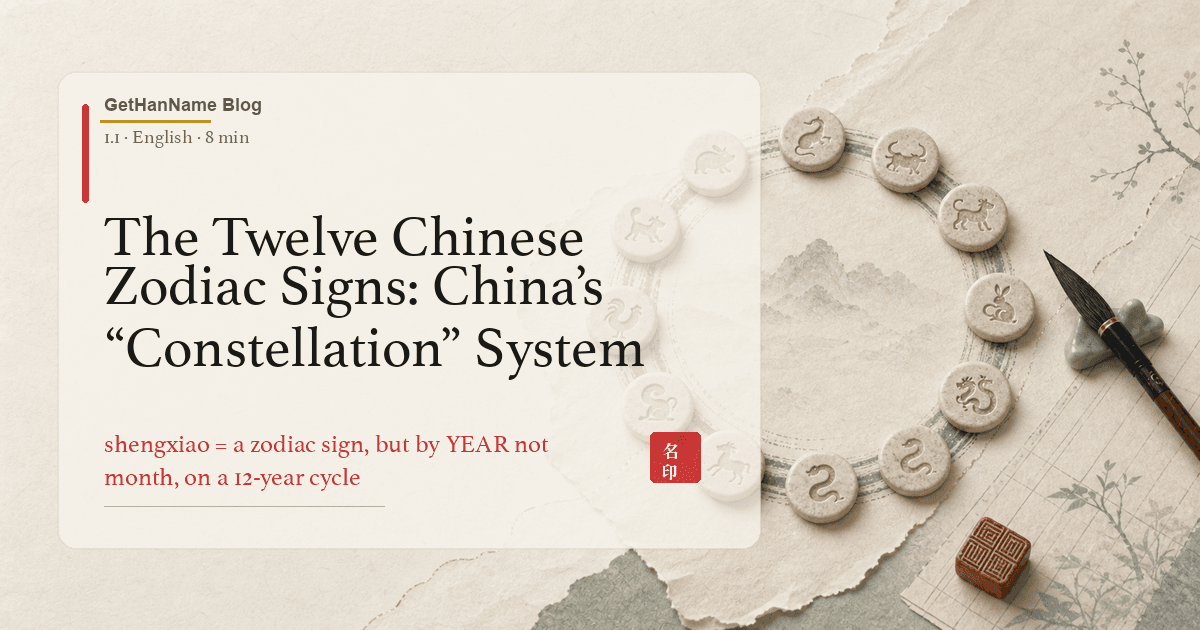
The Chinese zodiac is similar to the Western “constellation” system, but it is based on the year of birth with a cycle of 12 years. It uses a familiar Western analogy to explain the order of the Rat, Ox, Tiger, Rabbit, etc., and the pairing of earthly elements, as well as how this influences the selection of characters in Chinese names.
📝 TL;DR Summary
The Chinese Zodiac (shēngxiào, a system based on 12 animals) functions much like a “constellation” system in China—just as Westerners identify themselves as Aries or Leo according to their birth month, Chinese people identify themselves by their zodiac sign tied to the year they were born, such as “I am born in the Year of the Dragon” or “I am born in the Year of the Snake.” A full cycle completes every 12 years. Both cultures share the same instinct to label people based on their birth time, but they do so along different axes: one is horizontal (month), while the other is vertical (year). This article will take you just 8 minutes to understand this year-based “Eastern constellation” system.
I. A Polite Question, Two Ways of Asking It
In the West, when people first meet, they often ask, “What’s your sign?”—which means, “What is your zodiac sign?” The answer is usually determined by the month of birth: those born from late March to April belong to Aries (the Ram), those from late April to May belong to Taurus (the Bull), and so on. Behind this question lies a common practice that has been around for thousands of years: using the time of one’s birth to assign a concise “personality label.”
In China, in a situation very similar to this, people ask something different:
“Nǐ shǔ shénme?” (“What is your zodiac animal?”)
Do you notice the difference? Westerners ask about the month of birth, while Chinese people ask about the year. It’s the same underlying instinct, just applied along different axes—one horizontal (month) and one vertical (year).
So, the simplest way to put it is: Zodiac animals = China’s version of a zodiac system, except it follows a cycle based on “years,” completing one full circle every 12 years. In this article, we’ll use this analogy to help you understand this system thoroughly in just one go.
II. Core Analogy: The Chinese Zodiac = A “Constellation” That Changes Each Year
Fang Lichen, a researcher in the study of the zodiac, offers a very apt description—he refers to it as a theory of personality:
“The Chinese Zodiac is a simple and naturalistic theory of personality that originated among the common people.”
—— Fang Lichen, Zhèng Míng Dào Xìng – The Authoritative Guide to Chinese Name-Creation, Civil Aviation Press of China, 2007
Pay close attention to the term “theory of personality” in this quote—it precisely highlights how similar it is to Western astrology. Both systems aim to answer the same question: “What traits might a person possess based on the time of their birth?”
The difference lies in the “time scale” used:
| Dimension | Western Astrology | Chinese Zodiac |
|---|---|---|
| Types of symbols | 12 zodiac signs/constellations (Aries, Taurus…) | 12 animals (Rat, Ox, Tiger…) |
| Calculation basis | Based on month (which constellation the sun is in on the day of birth) | Based on year (which position in the 12-year cycle the year falls into) |
| Cycle length | Approximately 12 months (one full cycle per year) | 12 years (it takes 12 years to return to the same zodiac sign) |
| Origin inspiration | Celestial constellations / ecliptic belt | Cyclical time / Earthly Branches |
- Dimension
- Types of symbols
- Western Astrology
- 12 zodiac signs/constellations (Aries, Taurus…)
- Chinese Zodiac
- 12 animals (Rat, Ox, Tiger…)
- Dimension
- Calculation basis
- Western Astrology
- Based on month (which constellation the sun is in on the day of birth)
- Chinese Zodiac
- Based on year (which position in the 12-year cycle the year falls into)
- Dimension
- Cycle length
- Western Astrology
- Approximately 12 months (one full cycle per year)
- Chinese Zodiac
- 12 years (it takes 12 years to return to the same zodiac sign)
- Dimension
- Origin inspiration
- Western Astrology
- Celestial constellations / ecliptic belt
- Chinese Zodiac
- Cyclical time / Earthly Branches
Keep in mind the most crucial point: Western astrology completes one cycle in 12 months, while the Chinese Zodiac completes one cycle in 12 years.
Who Are These 12 Animals, and in What Order?
Chinese people know them by heart. Here is the list in order:
| Rank | Zodiac Sign | Pinyin | One-sentence impression |
|---|---|---|---|
| 1 | Rat | shǔ | Clever and adaptable; legend has it it won first place through its intelligence |
| 2 | Ox | niú | Diligent, steady, and patient |
| 3 | Tiger | hǔ | Brave and bold, the king of the forests |
| 4 | Rabbit | tù | Gentle, quick-witted, and popular among people |
| 5 | Dragon | lóng | Most revered, symbolizing nobility and good fortune |
| 6 | Snake | shé | Calm, profound, and wise |
| 7 | Horse | mǎ | Energetic, enthusiastic, and action-oriented |
| 8 | Goat/Sheep | yáng | Gentle, kind, and artistic |
| 9 | Monkey | hóu | Smart, lively, and fond of freedom |
| 10 | Rooster | jī | Hardworking, punctual, and loves to show off |
| 11 | Dog | gǒu | Loyal, honest, and values friendship |
| 12 | Pig | zhū | Easy-going, blessed with good fortune, and content with what they have |
- Rank
- 1
- Zodiac Sign
- Rat
- Pinyin
- shǔ
- One-sentence impression
- Clever and adaptable; legend has it it won first place through its intelligence
- Rank
- 2
- Zodiac Sign
- Ox
- Pinyin
- niú
- One-sentence impression
- Diligent, steady, and patient
- Rank
- 3
- Zodiac Sign
- Tiger
- Pinyin
- hǔ
- One-sentence impression
- Brave and bold, the king of the forests
- Rank
- 4
- Zodiac Sign
- Rabbit
- Pinyin
- tù
- One-sentence impression
- Gentle, quick-witted, and popular among people
- Rank
- 5
- Zodiac Sign
- Dragon
- Pinyin
- lóng
- One-sentence impression
- Most revered, symbolizing nobility and good fortune
- Rank
- 6
- Zodiac Sign
- Snake
- Pinyin
- shé
- One-sentence impression
- Calm, profound, and wise
- Rank
- 7
- Zodiac Sign
- Horse
- Pinyin
- mǎ
- One-sentence impression
- Energetic, enthusiastic, and action-oriented
- Rank
- 8
- Zodiac Sign
- Goat/Sheep
- Pinyin
- yáng
- One-sentence impression
- Gentle, kind, and artistic
- Rank
- 9
- Zodiac Sign
- Monkey
- Pinyin
- hóu
- One-sentence impression
- Smart, lively, and fond of freedom
- Rank
- 10
- Zodiac Sign
- Rooster
- Pinyin
- jī
- One-sentence impression
- Hardworking, punctual, and loves to show off
- Rank
- 11
- Zodiac Sign
- Dog
- Pinyin
- gǒu
- One-sentence impression
- Loyal, honest, and values friendship
- Rank
- 12
- Zodiac Sign
- Pig
- Pinyin
- zhū
- One-sentence impression
- Easy-going, blessed with good fortune, and content with what they have
Each Animal Is Associated with an “Earthly Branch”
These animals aren’t arranged randomly—they each correspond to one of 12 time symbols known as Earthly Branches (dìzhī):
Zǐ (Rat), Chǒu (Ox), Yín (Tiger), Mǎo (Rabbit), Chén (Dragon), Sì (Snake), Wǔ (Horse), Wèi (Goat/Sheep), Shēn (Monkey), Yǒu (Rooster), Xū (Dog), Hài (Pig).
So “Chén” is tied to the Dragon, and “Wǔ” is tied to the Horse. You often hear Chinese people refer to a birth year as a “Year of the Chén Dragon” or a “Year of the Wǔ Horse”—that’s exactly why. The Earthly Branches serve as the “skeleton” of the zodiac, while the animals act as its “face,” making it easier for ordinary people to remember.
Let’s Test It with Two Real Years
This system is simple to use—the zodiac sign you belong to corresponds to the position your birth year occupies in the 12-year cycle.
- Born in 2000 → Dragon (Dragon)
- Born in 2001 → Snake (Snake)
Name-related references also follow this same pairing (as noted in Fang Lichen’s Zhèng Míng Dào Xìng): the year of Jiazi corresponds to the Rat, the year of Yichou to the Ox, the year of Bingyin to the Tiger... and so on, all the way to the year of Yihai corresponding to the Pig. One full cycle takes 12 years, after which it starts over with the Rat. This is why Chinese people can immediately tell your zodiac sign just by hearing your birth year.
III. Back to Chinese Names: Why Do Zodiac Signs Influence Character Selection?
By now you might be wondering: What does this “Eastern zodiac” system have to do with choosing a Chinese name? The connection is quite significant.
Fang Lichen puts it very plainly:
"Naming based on the zodiac refers to a method where one combines the inherent traits and attributes of a person’s zodiac sign with their name selection... Each animal associated with a zodiac sign carries subtle symbolic meanings and represents the individual’s inner essence, while the name reflects their external characteristics."
—— Fang Lichen, Zhèng Míng Dào Xìng, Civil Aviation Press of China, 2007
In simpler terms: When naming someone in Chinese culture, people treat them as the animal corresponding to their year of birth. There is even a specific school within nameology textbooks known as the “Zodiac School (shēngxiàopài)”, whose core approach is:
"Zodiac School: This method analyzes whether the components of a name align with the preferences of the twelve zodiac animals represented by the person’s birth year.”
—— He Rongzhu, Textbook of Nameology, China Materials Publishing House, 2012
This leads to a practical naming logic—choose characters that match an animal’s habits and avoid those that go against them. Fang Lichen summarizes it thus: “Try to use characters favored by the zodiac sign... and steer clear of taboo characters as well as those that are incompatible or harmful to it.” (Zhèng Míng Dào Xìng)
Here are a few concrete examples:
- People born in the Year of the Dragon (lóng): In Chinese culture, the dragon is a celestial beast that controls weather, so names often include radicals like “water,” “cloud,” “sky,” or “celestial body” to give it room to “bring clouds and rain.”
- People born in the Year of the Snake (shé): Snakes prefer to hide and climb trees; they are referred to as “little dragons.” Therefore, names that imply submission rather than dominance—using characters like “minister” or “shell”—are considered suitable, as it suggests “advancement in status.”
- People born in the Year of the Monkey (hóu): Monkeys love forests and freedom. When naming them, one should avoid radicals that might “trap” them, since there are folk beliefs suggesting that pigs and monkeys together can cause negative outcomes.
In short, the zodiac sign is not just a standalone decorative element—it acts as a hidden filter in Chinese naming practices, quietly determining which characters are favored and which are avoided. This is also why the same character might enhance a name for someone born in the Year of the Dragon but may not work well for someone born in the Year of the Monkey. (We’ll go into more detail about specific suitable and prohibited radicals in section 7.3 of the next article in this series.)
IV. Back to Reality: How Did This “Eastern Zodiac” Seep Into Chinese Life?
Now that you understand that the zodiac corresponds to annual constellations, it’s easier to make sense of these seemingly “strange” Chinese customs:
Scene 1: The “Zodiac Economy” Booms During Lunar New Year.
When the Year of the Dragon arrives, businesses across China instantly replace their products with dragon motifs—red envelopes, bubble tea cups, sneakers, and more. While Westerners check their monthly horoscopes, Chinese people welcome a new zodiac animal each year, akin to getting a new “annual mascot.”
Scene 2: Elders Check Zodiac Compatibility When Discussing Relationships.
There’s a popular belief in China about matching zodiac animals—such as the idea that rats and oxen go well together, while dragons and chickens form a harmonious pair (“Six Harmonies”), whereas rats and horses or tigers and monkeys are considered incompatible. As a result, some elders may discreetly check whether two children’s zodiacs match before they start dating. It’s important to note that this is mostly a folk tradition for fun; most young people today take it lightly at best.
Scene 3: People Feel “Nervous” at Ages 12, 24, and 36.
Chinese people refer to the year that matches their own zodiac as a 本命年 (běnmìngnián)—an event that occurs every 12 years. Traditionally, people wear red socks or tie red threads during this time as a protective measure, viewing it as a year that requires extra caution.
💡 Cultural Tip: These customs are expressions of traditional wisdom and folk traditions that have been passed down for thousands of years. They reflect the Chinese philosophy of living in harmony with nature’s rhythms, rather than being strict rules that dictate fate. Think of them as a window into Eastern culture—approach them with openness and ease.
V. Practical Tips for You
Whether you are Chinese or not, understanding the Chinese zodiac can give you an extra perspective when “reading” Chinese names. Here are three simple steps:
-
Find out your own zodiac sign first. Search online for “chinese zodiac calculator” and enter your birth year. Note: If your birthday falls in early January or February, check whether the “Start of Spring” or the Lunar New Year has already passed for that year (the classification for boundary dates is explained in the FAQ section below).
-
Keep track of the “preferred character roots” associated with your zodiac sign. For example, those born in the Year of the Dragon in 2000 might want to consider characters like “water,” “cloud,” “chen,” and “rain,” which are considered compatible with the dragon’s nature when choosing a name.
-
Think of it as a “plus factor,” not a strict rule. The zodiac is just one cultural element to consider when naming. A great name is always the result of a balanced integration of sound, structure, meaning, zodiac compatibility, and the five elements.
Looking for a Chinese name that is truly “suitable” for you and takes your zodiac into account? Give GetHanName a try—we don’t just “translate” your English name; we create a meaningful Chinese name tailored to your zodiac sign and personal preferences.
VI. Frequently Asked Questions (FAQ)
Q1: Are the Chinese Zodiac and Western astrology the same thing?
They belong to different systems, though they share a similar underlying idea—both attempt to assign traits based on one’s time of birth. The key difference lies in how they categorize the signs: Western astrology uses months to define 12 zodiac signs, while the Chinese Zodiac relies on years to designate 12 animals that cycle every 12 years. One looks to the stars in the sky, the other to the years on earth.
Q2: Why are there exactly these 12 animals? Why isn’t a cat included?
The most popular folk story involves a “river-crossing race”: a rat rode on an ox’s back and took first place, while a cat was tricked by the rat and failed to keep up, thus being excluded—this is also why cats and rats are natural enemies. However, this is just a legend; historians have offered alternative explanations (see Extended Reading 7.2 for details).
Q3: Can my zodiac really determine my personality?
Traditional Chinese culture views the zodiac as a simple theory of personality traits and a reference for folk customs, with varying levels of acceptance among different people. For most individuals, it functions more like a cultural tradition and set of pleasant associations rather than an unchangeable rule that shapes one’s life. Understanding it helps in grasping the context of Chinese culture, not as a constraint on oneself.
Q4: My birthday is in January or early February—how do I determine my zodiac?
This is where mistakes are most likely to occur. The zodiac is divided by the Lunar New Year (or traditionally, “Lìchūn,” the first of the 24 solar terms). If you were born at the end of January or in early February, you may fall across two zodiac years, and your specific birth date will be needed to determine which one applies. It’s recommended to use a “Chinese zodiac by birthday” tool to verify.
VII. Further Reading
- 📖 Why Isn’t There a Cat in the Chinese Zodiac? —— Behind the legend of a “river-crossing race” lies another interpretation of how the zodiac animals are ordered.
- 📖 Best Practices and Pitfalls When Naming with Zodiac Elements: Dragons Love Water, Monkeys Prefer Forests —— Want to know which characters suit your zodiac sign and which ones should be avoided? This guide offers practical advice.
- 📖 Differences in Naming Between Those Born in the Year of the Dragon and the Year of the Tiger —— Using two of the most popular zodiac animals, this article breaks down the logic behind naming based on the year.
References
- Fang Lichen, Zhèng Míng Dào Xìng – An Authoritative Guide to Chinese Naming Traditions, Civil Aviation Press of China, 2007. (Discusses theories related to zodiac personality traits, compatibility and incompatibility between zodiac signs and names, as well as preferred and avoided characters.)
- He Rongzhu, Textbook of Name Studies, China Materials Publishing House, 2012. (Explains how the “zodiac-based name theory” defines the preferences of each of the twelve zodiac animals represented by the year’s Earthly Branch.)
- The sequence of the 12 zodiac animals, the pairing of Earthly Branches (Rat... Pig), and their correspondence with birth years in this article are all compiled based on the aforementioned sources.
This article is original content from GetHanName’s blog, first published on gethanname.com. Please contact us if you would like to reproduce it.
Related articles
Why Aren’t Cats in the Chinese Zodiac? — The Legend Behind the Zodiac’s Order
Why Isn’t There a Cat in the Twelve Chinese Zodiacs? The most popular folk explanation is a “river-crossing race” — the rat rode on the ox’s back to win first place, while the cat was pushed into the water and missed out. This explains the legends behind the zodiac order, why the rat ranks first, and its connection to the choice of Chinese names.
Which Characters Should Be Avoided in Your Name Based on Your Zodiac Year?
Zodiac taboos are like “food allergies” — some character roots clash with your zodiac’s temperament, while others act as allergens. Using six representative animals—dragon, tiger, monkey, and rat—we explain which characters to choose and which to avoid when naming based on one’s zodiac.